
Are you hunting for the best bridge cameras to upgrade your photography without carrying heavy gear? You deserve the freedom to capture breathtaking photos using just one powerful device. These superzoom wonders offer stunning versatility that your smartphone simply cannot match. We tested the top all-in-one models to help you snag the ultimate shot every time. Let’s explore the perfect picks for your next adventure.
Contents
- Top 5 Crossbow Scopes:
- 1. Vortex Optics Crossfire II Second Focal Plane Crossbow Scope
- 2. Hawke XB1 Crossbow Scope
- 3. UTG Crossbow Scope
- 4. TRUGLOarchery-Crossbow-scope
- 5. CVLIFE Optics R4 Reticle Crosshair Scope
- Things to Consider Before Buying a Crossbow Scope:
- Fixed Power Scopes
- Variable Power Scopes
- Magnification Levels
- Reticle Types
- Advantages
- Disadvantages
- Personal Preferences
- Use Case Scenarios
- Mounting the Scope
- Sight Adjustment
- Storage Recommendations
- Summing up
Top 5 Crossbow Scopes:
1. Vortex Optics Crossfire II Second Focal Plane Crossbow Scope

The Vortex Crossfire II 2-7×32 kit provides precision from first light to last light and is a speed-calibrated optic that is ready to be mounted on your crossbow. Stacking bolts is made easy with the included scope, 30 mm rings, flip caps, and neoprene cover.
The XBR-2 reticle will allow you to aim more quickly and with more precision. Get your bearings at 40 yards, and then shoot quickly from 20 to 100 yards using the crisp holdover ladder. In dim light, your aiming points will remain sharp thanks to dual lighting, which won’t overwhelm your target.
To maintain consistent drop statistics across configurations, adjust the speed/magnification ring to correspond to your bow’s FPS. You can swiftly locate game in dense cover with the 2× broad field of view; for longer shots, zooming to 7× allows for perfect placement. The anti-reflective, fully multi-coated lenses increase light transmission, resulting in a brilliant and contrasty sunrise and sunset view.
Constructed for hunting, the one-piece aluminum tube resists shock and rebounds easily. Its small, 14-oz form fits comfortably on modern crossbows, and its O-ring sealing and nitrogen purging make it waterproof and fogproof despite temperature changes.You can confidently range, aim, and release with accuracy with the Crossfire II SFP kit, a reliable and easy-to-tune crossbow scope with clear glass, intuitive grips, and tough waterproof construction.
2. Hawke XB1 Crossbow Scope

The Hawke XB1 is an excellent choice for a crossbow scope because it is easy to set up and maintains accuracy at genuine hunting speeds. Your 1.5-5× magnification follows bolt drop without guesswork when you set the speed-calibrated power ring to your bow’s FPS and the SR reticle’s hold points align automatically.
Confidence shines through even in dim light. The illuminated SR reticle is available in green or red and has adjustable brightness levels, allowing you to choose the optimal aim point in low light without blinding yourself. Bright, high-contrast images are produced by fully multi-coated lenses, which allow for accurate placement even while working with a variety of backgrounds and brushes.
We are prepared for any hunt. With an aluminum chassis weighing around 12.96 oz and a nitrogen-purged 1″ mono-tube that is waterproof, fogproof, and shockproof, your rig will be well-balanced and ready for rigorous travel in harsh weather.Finding the zero is easy. The fast-focus eyepiece brings the reticle into great relief, allowing you to fine-tune clarity to your eye on the spot, and the positive, tactile adjustment clicks make corrections easy.
Important information: a magnification range of 1.5-5×, an objective of 1″, a speed-calibrated crossbow-specific SR reticle, lighting in red and green, fully multi-coated glass, and a sturdy all-weather build.
Looking for a small, reliable crossbow optic that can keep up with your bow’s pace, remains clear in varying lighting conditions, and withstands real-world use? The Hawke XB1 is a sturdy, lightweight option that offers calibrated holds and clear glass.
3. UTG Crossbow Scope

The UTG 4×32 Crossbow Scope is designed for those who desire a small crossbow optic that maintains zero and remains clear under pressure. You can confidently collect targets from a stand or blind and place shots thanks to the bright and large field of vision provided by the fixed 4× magnification and 32 mm objective.
Under recoil, the accuracy will be appreciated. For precise, repeatable windage/elevation adjustments and rock-solid zero retention, shot after shot, UTG’s True Strength platform with Smart Spherical Structure (SSS) maintains internal alignment. Aim points can be better seen in low light conditions, where brush and shadows are more prevalent, thanks to precision broadband lens coatings that increase light transmission and contrast.
The zeroing process is simple and remains so. You can dial in, lock settings to avoid drift, and reset to zero with premium, zero-lockable, resettable target turrets. The on-range corrections are easy and predictable because to the positive tactile clicks.The metal chassis of modern crossbows is small and built to withstand rigorous travel and hard knocks, making them ideal for hunting. A scope with clear glass, sturdy build, and simple controls is the end product.
Every time you nock a bolt, the UTG 4×32 will provide you with assured, field-ready performance, thanks to its dependable 4× scope, clear optics, precise tracking, and platform that can withstand crossbow recoil.
4. TRUGLOarchery-Crossbow-scope

The TRUGLO 4×32 is an excellent choice if you are looking for a small crossbow scope that is easy to zero, has good clarity, and is long-lasting. With its scratch-resistant, non-reflective matte finish and one-piece, aircraft-grade aluminum construction, this tube holds zero consistently and aids in concealment in the stand or blind.
A clear and vivid sight picture will be yours. The nitrogen filling makes the scope fog-proof, and the sealed design is water- and shock-resistant, so your setup will remain unaffected by changing weather conditions or recoil. The fully coated lenses enhance brightness and contrast, and the substantial 4″ eye relief keeps the view comfortable behind the string.
The range-finder/bolt drop-compensating BDC layout gives you clean hold points for common crossbow distances, allowing you to confidently place bolts without constant dialing. A purpose-built reticle speeds up aiming. You can quickly and precisely zero in at the range with positive clicks from the fingertip, leaf-spring windage, and elevation adjustments.
The scope has an elastic lens cap to protect your glass during shipping, and it comes with weaver-style rings for convenient installation. With a fixed 4× and a 32 mm objective, it gives a broad field of vision, allowing you to easily pick up game and provide adequate magnification for precision placement.
The TRUGLO 4Ï32 provides dependable performance from first light to last if you are seeking a tough, hunter-ready 4× crossbow optic with clear glass, practical holdover markers, and simple, dependable controls.
5. CVLIFE Optics R4 Reticle Crosshair Scope
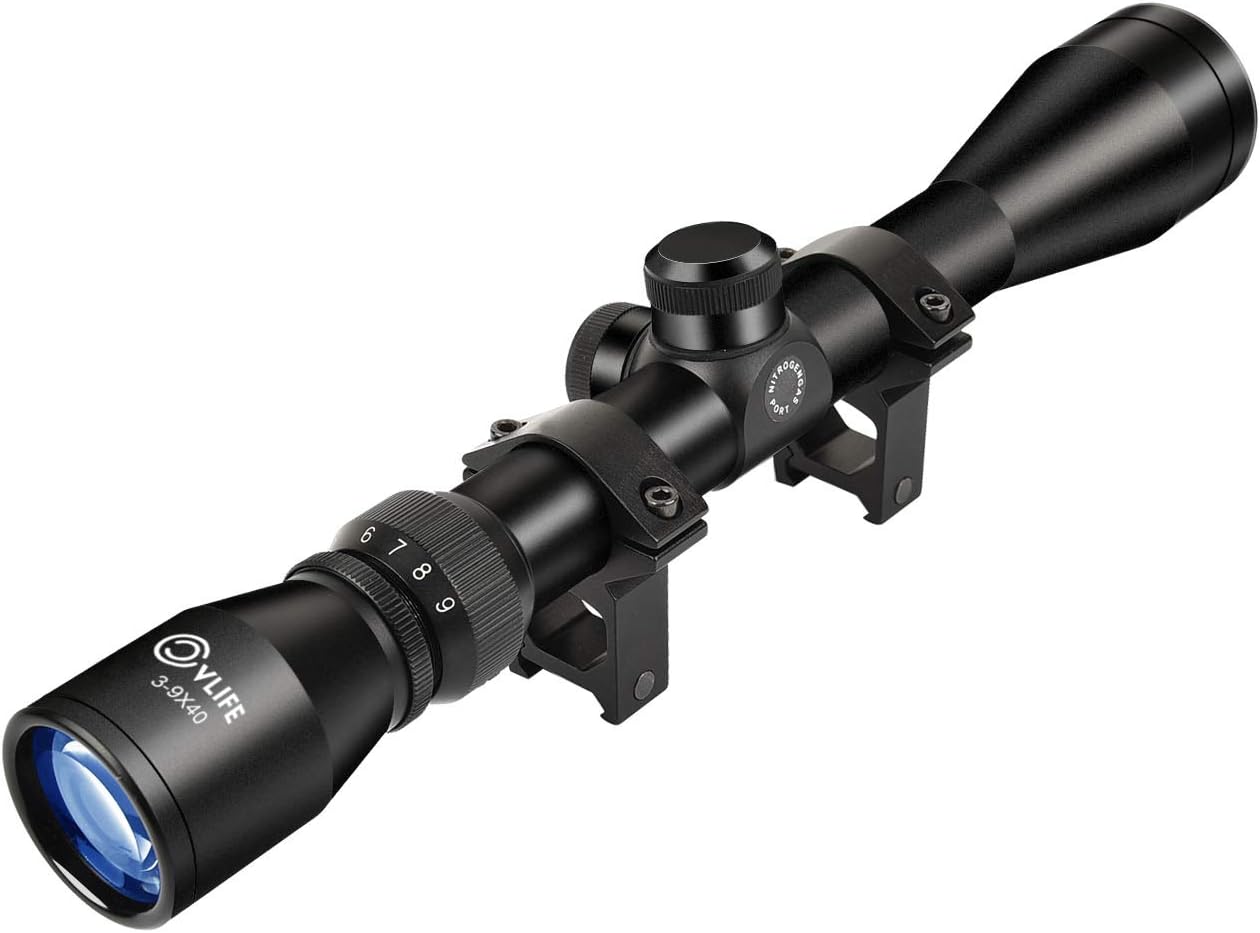
The CVLIFE Optics R4 Reticle Crosshair Scope is perfect for those who prefer a minimalist optic that allows for clear and self-assured shots without any unnecessary visual clutter. You can easily center targets whether hunting or practicing at the range with the classic R4 crosshair—simple four posts with a fine center. Scan at 3x for tight cover or dial up to 9x for more precise mid-range holds with the adjustable 3-9x magnification. An approximately 0.2-inch exit pupil and a 40 mm objective lens provide a brilliant and forgiving sight picture over most of the zoom range, allowing adequate light to be captured.
You’ll also like how well-balanced your weapon is. The scope won’t add unnecessary weight to your setup at only 0.76 lb, and its 12.20-inch length makes it easy to shoulder and carry in the field. Installation is a breeze on the majority of rifles thanks to the “free mount” design’s compatibility with standard rings and bases. Once mounted, the simple crosshair allows you to construct a consistent sight picture with the help of alignment, breathing, and squeezing, allowing you to concentrate on the shot rather than battling with cluttered reticles.
This lightweight scope offers the essentials you need to shoot with confidence: clear aim points, practical zoom, and compatibility with a wide selection of hunting rifles.
Things to Consider Before Buying a Crossbow Scope:
Buying a crossbow scope requires assessing your shooting distance, target type, mounting compatibility, reticle style, light transmission, parallax adjustment, and durability to ensure accurate, consistent performance; you should match magnification to typical ranges, confirm fit with your rail and bolts, choose a reticle that supports rangefinding or holdover you prefer, and factor in glass quality, coatings, and ruggedness for field conditions.
Fixed Power Scopes
You’ll find fixed scopes (commonly 4×30) deliver repeatable POI with fewer moving parts, lower weight, and prices often 20-40% below comparable variable models, making them excellent for consistent short-range shots where you rarely change magnification.
Variable Power Scopes
You can adapt variable scopes-typical ranges 2-7x or 3-9x-to different distances and targets, improving accuracy from 15-80 yd; expect slightly more weight and the need to confirm zero at multiple magnifications.
You should weigh trade-offs: variable optics let you use the same scope for bolts at 20 yd and 60 yd, but check for parallax shift and reticle subtension changes; choosing a scope with indexed magnification clicks and clear BDC marks or an FFP that scales with magnification can simplify holdover at varied ranges.
Magnification Levels
You’ll pick fixed or variable magnification based on your shot distances: 1-3× is ideal for rapid target acquisition inside 40 yards, 4× fixed offers simplicity and repeatable holds, and 4-6× or variable 1-6× gives precision out to 60-70 yards; factor scope bulk and parallax when increasing power.
Reticle Types
You can opt for a simple duplex reticle for fast aiming, a BDC calibrated to common arrow speeds for quick holdovers, mil-dot for range estimation and wind compensation, or an illuminated reticle for low-light work; choose FFP if you need consistent ranging across magnifications, otherwise SFP keeps subtensions stable.
You should match reticle choice to your arrow velocity and typical distance: a BDC tuned to a 350 fps arrow gives usable yardage marks out to 60 yards, mil-dot requires you to know subtension math or use phone apps, and illuminated reticles help at dawn but may bloom against bright backgrounds.
Advantages
You gain measurable improvements in shot placement when using a scope matched to your crossbow: 1-4x magnification and ballistic reticles tuned for 20-60 yards let you hold precise points of aim, and illuminated options give 50-200 hours of usable battery life depending on brightness. Many shooters report tighter group sizes and faster target acquisition compared with open sights, especially in low-light dawn or dusk conditions.
Disadvantages
You should expect trade-offs: better optics add weight and cost, often , and illuminated reticles rely on batteries that can fail. Also, higher-magnification scopes reduce field of view, making moving targets harder to track, and some models need periodic re-zeroing after transport or hard impacts.
Parallax and eye-relief sensitivity amplify practical downsides: fixed-parallax scopes can shift point-of-impact if your eye position moves, so you must maintain a consistent cheek weld. For example, a 4x scope with 2.5-3.5 in of eye relief can translate small head shifts into several inches at 40 yd. Additionally, follow mount torque specs and check zero after roughly 20-30 firm shots or any rough handling to avoid surprises in the field.
Personal Preferences
You may prefer a simple duplex reticle and fixed 4× if you hunt from blinds inside 40 yd, while others choose 6-18× variable glass for occasional 100+ yd shots. If you routinely hike 3-5 miles per outing, shaving 4-6 oz matters to reduce fatigue. Test eye relief (3-4 in) and compare low‑light clarity with 40mm+ objectives; your comfort with reticle style and weight often determines long‑term satisfaction.
Use Case Scenarios
You’ll pick different scopes based on hunting style: treestand hunters (20-45 yd) benefit from 1-6× fast‑focus optics; spot‑and‑stalk hunters covering hilly terrain need 4-12× with robust mounts; target shooters engaging 50-150 yd favor 10-20× with precise turret adjustments. Factor in illumination for twilight shots and ED glass for sharper resolution at longer ranges.
If you hunt dense brush in eastern whitetail country, choose 1-4× or 2-7× to keep target acquisition fast-many hunters report up to 30% faster follow‑ups with lower magnification versus fixed 10×. When you regularly engage targets at 100-150 yd, opt for 12-20× with a fine mil‑dot or MOA reticle and exposed turrets for quick zeroing and elevation corrections. Match your most common scenario to the scope’s core features.
Mounting the Scope
Start by matching ring diameter to your scope tube (1″ or 30mm) and position rings on the Picatinny rail so you can achieve 3-4″ of eye relief; you should center the reticle tube before snugging. Apply medium thread locker to base screws, then torque ring caps evenly to about 15-18 in‑lbs in a crisscross pattern. Verify 1/4″-1/2″ clearance between scope and bolt flight path before final tightening.
Sight Adjustment
Zero at a practical range-most users begin at 20 yards then confirm at 40 yards-because crossbow trajectories drop quickly; after settling on a 3‑shot group, use the scope’s windage/elevation clicks to move point of impact. Keep in mind many scopes click in 1/4 MOA (0.25″ at 100 yds), which equals ~0.05″ per click at 20 yds, allowing precise micro‑adjustments for small groups.
When fine‑tuning elevation, shoot consistent 3‑shot groups with the same bolts and speed; modern crossbows typically run 300-400 fps and that velocity affects drop, so record holdover values at 20, 30, and 40 yards. Use the reticle’s reference marks or a ballistic table to set secondary aiming points, and always recheck after any equipment change or temperature shift.
Storage Recommendations
You should store your scope in a padded, lockable case at stable temperatures-ideally 40-80°F (4-27°C)-with relative humidity around 30-50%; keep lens caps on and remove batteries from illuminated reticles to prevent leaks. Place 1-2 silica gel packs per 2 liters of case volume to control moisture, and avoid attics, basements, or vehicle trunks where temperature and humidity swing widely.
For longer-term storage, unmount the scope or slightly relieve ring tension to avoid constant stress on the tube, coat exposed metal with a thin layer of gun oil to deter rust, and inspect every 3 months: check silica packs (replace when indicator changes or every 6 months), wipe down surfaces, and verify illumination batteries are removed or replaced as needed so the scope is ready and zero checks are minimal when you next mount it.
Summing up
To wrap up, weigh your shooting distance, reticle type, parallax adjustment, magnification needs, durability, and mounting compatibility before buying a crossbow scope; prioritize clear optics, reliable zero retention, and ease of adjustments so you keep shots consistent, and ensure the scope matches your hunting or target setup and budget to get dependable performance in the field.
Leave a Reply