
Finding the best MTB helmets is the most important gear decision you’ll make for your safety on the trail. Your helmet is the one piece of equipment essential for confident trail riding and serious head protection. We’ve done the hard work, testing the top models to find the absolute best. This guide will help you discover the ultimate helmet to protect your head and elevate your ride. Let’s dive into the top picks for this year.
Contents
- Top 5 MTB Helmets:
- 1. BELL Super Air R MIPS Adult Mountain Bike Helmet
- 2. BELL Super 3R MIPS Adult Mountain Bike Helmet
- 3. SMITH Forefront 2 MIPS Adult Mountain Bike Helmet
- 4. Fox Racing Speedframe Mountain Bike Helmet
- 5. Giro Fixture II MIPS Mountain Bike Helmet
- Things to Consider Before Buying a MTB Helmet:
- Full-Face Helmets
- Half-Shell Helmets
- Convertible Helmets
- Fit and Comfort
- Safety Standards
- Ventilation
- Full-Face Helmet Advantages
- Half-Shell Helmet Disadvantages
- Cleaning Your Helmet
- Storing Your Helmet Properly
- Conclusion
Top 5 MTB Helmets:
1. BELL Super Air R MIPS Adult Mountain Bike Helmet

If you’re looking for enduro-level coverage and all-mountain features, then the BELL Super Air R MIPS is your helmet. The Fusion polycarbonate shell is directly connected with the EPS liner that makes it a stronger construction, and progressive layering uses variable-density foam to better manage the transfer of energies after some hits. That means assured coverage on even slow technical spills and faster hits, whatever the sport.
Flex Spherical + MIPS incorporates a two-layer slip-plane system to reduce forces positioned at critical moments of impact. Get total energy control without sacrificing airflow or fit, so you can look forward to getting on the line instead of your pounds-per-square-inch score.
Dial comfort for big days. Quick-dry padding with X-Static materials uses a silver fiber woven in with the pad to keep it cool and manage odor. The Overbrow Ventilation draws cool air in through the front and pushes it through the air-channel matrix of the shell, so you stay cool on long climbs or up-lifted park laps.
Trail versatility is built in. The no-tools wraparound chin bar provides extra coverage when the trail turns gnarly, but is easily removed and stashed in your pack when you’re ready to let the wind rush across your face. The GoggleGuide adjustable visor system also accommodates goggles and glasses (no interference with the spray, thank you), and works with or without the visor attached.
You receive the adaptable protection of Koroyd, the airy and cool fit of AirEvac ventilation and two-layer construction with elastic modulus absorption in one ultimate helmet designed for the road and beyond.
2. BELL Super 3R MIPS Adult Mountain Bike Helmet
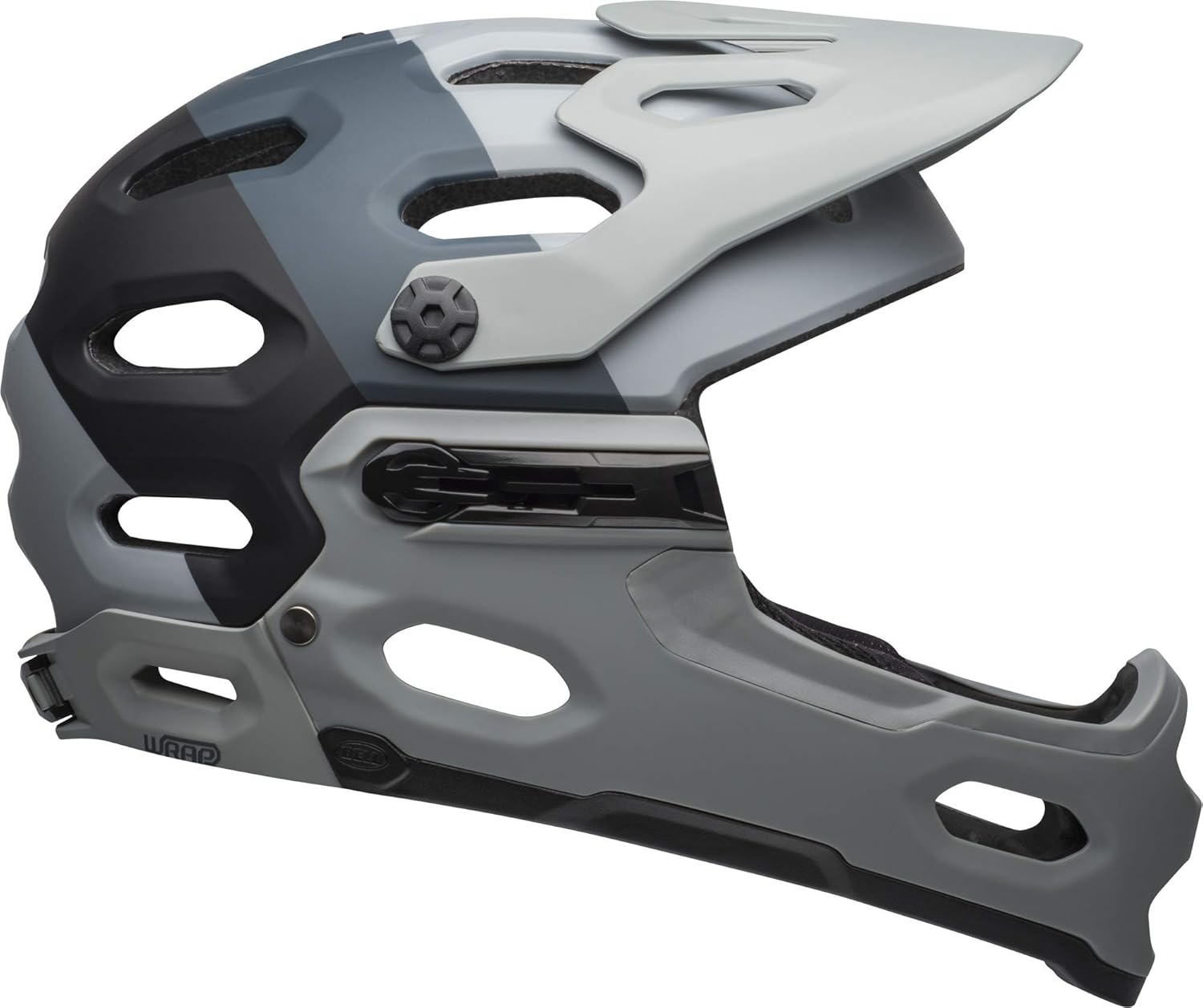
For a helmet that adjusts to every ride, whether you prefer long climbs or fast descents, choose the BELL Super 3R MIPS; with a removable chin bar for when extra protection is necessary. You get everyday comfort and fit dialed in quickly: New No-Twist Tri-Glides hold the straps flat and close to your face, XT2 Padding provides full support and long-lasting odor protection, that agion technology is permanently integrated into this padding and so it ship preps you for hot dusty conditions with out washing or seasoning.
The safety tech is designed for real-world crashes. This is made possible by the MIPS (Multi-directional Impact Protection System) slip-plane, which can account for certain angled impacts to increase off-axis protection within the EPS liner. When the terrain goes up, a simple three-step, no-tools process makes it easy to lock in one of six (yes, you read that correctly) six downhill-dominant chins and wind downwind with wraparound protection; when you’re pinning fire-roads or grinding climbs, remove the chin for a lighter option.
There is no difference in airflow when the speed is changed. Overbrow Ventilation intakes cool air at the front and ushers it through the interior to help you keep your cool on long, hot climbs or when recovering between laps.
Trail-friendly features complete the package. The helmet’s GoggleGuide adjustable visor system is consistent with glasses or goggles, and also functions when you want to pedal without the visor attached.
Select the all-new Super 3R and choose the easy way….Back on!The one helmet to haveThanks to its unique reversible design, the SUPER 3R MIPS is also capable of transforming into a full face helmet when time comes; just push the buttons and release.
3. SMITH Forefront 2 MIPS Adult Mountain Bike Helmet

If you’re after a trail helmet that strikes the perfect balance between protection, ventilation and a secure fit then the SMITH Forefront 2 MIPS is ready to go as hard as you do. Its full-wrap coverage wraps around your skull to the front and back and side to side, plus the added protection of a MIPS slip-plane system which provides extra rotational impact protection if you fall on technical terrain.
You feel cooler and clearer when the pace quickens. Twenty fixed vents gradually convey air through the shell to assist in temperature regulation on extended climbs and hot laps. The Ionic+ lining utilizes sweat-activated fibers to aid with odor and comfort, while the Ambient Strap Technology features soft and grippy rip-and-stick webbing that’s easy to adjust (no tangle!) See Eye Size Guide[‘ Ride with glasses or goggles without the fog: no sweat – this is wicking!; way Vapour active, mega stretch, super light fabrics combined to deliver ultimate quick dry action so you won’t be distracted by any moisture build-up on the inside of your lens and frames, and a cut that lets your face breathe (made with recycled fabric).
Fit is fast to configure and easy to secure. The VaporFit dial system provides 270° of micro-adjustment, with enough movement to address tension around the entire head, not just on top and bottom. Meanwhile, the adjustable visor is strategically designed to adjust on-the-fly for goggle storage, and keeps your goggles in place when you’re smashing through rough terrain.
Opt for the Forefront 2 MIPS if you want a lightweight, highly-adjustable helmet that performs well in any type of riding – and has modern impact management so even when you’re drilling it, flowing hero dirt back to the trailhead comes comfortable and confident.
4. Fox Racing Speedframe Mountain Bike Helmet

If what you are looking for is a trail helmet that stays cool, fits snug, and offers modern crash protection, the Fox Racing Speedframe is an easy choice. You receive the proven MIPS® system designed to reduce rotational forces that can result from certain impacts and we use an in-mold EPS liner to help manage impact energy. And as a result, you can huck into technical lines with that much more confidence.
Dialing in comfort is straightforward. The 360° fit system conforms to the shape of your head, with a quickbeclip feature that allows you to tighten evenly around your head with one hand; the adjustable straps let you tweak placement for tightness over bumpy terrain. When you’re out for some warm rides, channeled EPS maintains airflow over the top of your head while working to draw hot air away from your skull as well to help keep that temperature down and you riding stronger longer.
Your eyewear setup is covered. The goggle-compatible visor adjusts to three positions, and remains conveniently out of the way when you don’t need it, even if your goggles are on the back of your helmet. Removable, washable comfort liner wicks away sweat and makes it easy to keep things fresh ride after ride-inside and out.
Pick the Speedframe if you value reliable MIPS coverage, lots of air flow, and a fit that is arrachive Ready in clean trail style. For workday commute or weekend adventure, it has the safety technology of lights and reflective tape you rely on, with a vent system to hold your cool all day long.
5. Giro Fixture II MIPS Mountain Bike Helmet

If you’re after a trail helmet that gets the basics right, such as protection, airflow and simple sizing options, but comes in at a budget-friendly price without any fuss, then the Giro Fixture II MIPS will serve you well. Tested and proven in Giro’s category-leading test lab, it features a layer of coolmax padding to keep you comfortable so you can focus on the ride.
You also have integrated MIPS Multi-Directional Impact Protection System, which should help redirect rotational forces in some types of crashes. That extra slip-plane works in concert with the EPS foam liner to help manage impact energy and elevate confidence on technical singletrack or during daily commutes.
Staying cool is straightforward. Eighteen Wind Tunnel™ vents pull in cool air as you ride, directing it through internal channels to keep you cool and comfortable – but the TAZ 5 heat won’t be slowing down any time soon! Grinding a climb or flowing a descent, the ventilation keeps you at a more consistent temperature so you can work harder between efforts.
The shell has durability inside and out. Durable in-mold construction combines the polycarbonate outer shell with an impact-absorbing liner for lasting strength and a cool, comfortable style. With its Universal Adult size, it fits a variety of head shapes and uses an adjustable fit system to control tension as you dial in the fit for a comfortable, pressure-free hold.
Pick up the Fixture II MIPS if you want a durable, comfortable helmet that offers top protection and ventilation at an affordable price, with all of the testing and certifications to back your confidence on your favorite loops and new trails.
Things to Consider Before Buying a MTB Helmet:
Over your rides, you should choose an MTB helmet that balances protection, fit, ventilation, and weight to match your riding style. Check certification (CE/ASTM), consider rotational-impact tech like MIPS, verify the retention system and cheekpad fit, ensure adequate rear coverage and a secure visor, and test comfort with your goggles and hydration gear to avoid distractions on trail.
Full-Face Helmets
You’ll get complete jaw and facial coverage with full-face helmets, which are standard in downhill racing and protected by standards like ASTM F1952; weights typically range from about 900 to 1,400 grams, and many models integrate MIPS or similar rotational-impact systems to lower concussion risk.
Half-Shell Helmets
You should favor half-shell helmets when you prioritize lightweight comfort and airflow—typical weights are 250–400 grams—so you get better ventilation on climbs, wider field of view, and easier helmet storage when off the bike.
For additional context, manufacturers often include multi-density EPS, adjustable visors, and extended rear coverage for the occiput; models from Giro, Bell, and POC demonstrate how fit systems (dial adjusters, removable pads) and MIPS layers can improve protection without adding much weight.
Convertible Helmets
You can switch a convertible helmet from open to full-face by clipping on or removing a chin bar, making them ideal for enduro riders who tackle both climbs and technical descents; expect weights around 500–900 grams and check whether the chin bar locks securely under impact.
In practice, popular convertible models like the Bell Super Air R and Giro Switchblade show the trade-offs: slightly reduced ventilation and higher mass than half-shells, but real-world versatility—pit crews and shuttle riders value the quick-change capability during multi-stage rides and races.
Fit and Comfort
Measure your head circumference at the brow line and use sizing charts—S 54–55 cm, M 56–58 cm, L 59–61 cm—as a starting point, then try helmets for uniform pressure around the crown. Check the retention dial, Y-strap placement below the ear, and cheek pad fit so goggles sit flush under the visor; retention systems with micro-adjustment improve stability. You should prefer models with removable/washable pads and a snug chin strap for long rides.
Safety Standards
Look for CPSC (US) or CE EN 1078 (EU) labels for general mountain biking, and ASTM F1952 for downhill/full-face helmets; Australia/New Zealand use AS/NZS 2063. Standards specify impact velocities, energy attenuation, and test protocols—CPSC focuses on single-impact linear tests while ASTM F1952 covers higher-energy impacts and chin-bar criteria. You should inspect the interior sticker to confirm which standard applies to the helmet.
Standards rarely mandate rotational-impact mitigation, so systems like MIPS, SPIN or WaveCel are voluntary technologies intended to reduce rotational forces in oblique impacts. Check the helmet’s production date—polymers degrade over time—and follow manufacturer guidance on replacement after a crash or after roughly 3–5 years of regular use. You should also review warranty and certification documentation before buying.
Ventilation
Vent counts and channel design dramatically affect comfort: XC helmets often feature 18–24 vents for maximum airflow, trail helmets 10–16 vents with deeper channels, and full-face helmets use fewer large ports plus chin-bar vents. Larger ports cool more effectively during climbs but can reduce insulation on cold rides; removable pads and mesh can help manage sweat. You should match venting to your typical riding climate and effort level.
Internal baffles and directed channels guide air from intake to rear exhaust—look for balanced intake and exhaust ports to create effective airflow; some manufacturers publish CFD or wind-tunnel data for top models. Full-face designs typically include 3–6 main vents plus dedicated chin vents to prevent fogging of goggles. You should test airflow on a short ride or by feeling airflow with the helmet on to confirm real-world performance.
Full-Face Helmet Advantages
You get comprehensive cranial and facial coverage with a full-face helmet, which is why World Cup downhill and many enduro racers use them; the chin bar deflects direct impacts and reduces facial fractures, and integrated venting plus removable liners let you adapt for summer rides or colder days.
Half-Shell Helmet Disadvantages
You face increased vulnerability to jaw and face impacts when riding a half-shell because there’s no chin bar; on technical, high-speed trails a glancing or forward strike can contact your lower face, and many racers switch to full-face for stages with sustained exposure.
On roots and rocky descents you’ll notice the difference: without a chin bar your jaw, teeth, and lower face are exposed to sticks and ledges that commonly cause lacerations or dental trauma in crashes; additionally, half-shell shells often have less structural reinforcement around the temples, so you should assess terrain and riding style before choosing one.
Cleaning Your Helmet
Remove removable pads and hand-wash them with mild dish soap or baby shampoo; clean the shell and vents with a soft cloth and lukewarm water. Avoid machine washing, bleach, solvents, or high‑alcohol cleaners that can degrade liners. Air dry padding and shell out of direct sunlight; clean after muddy rides or roughly every 2–4 weeks depending on usage to prevent odor and sweat buildup.
Storing Your Helmet Properly
Keep your helmet in a cool, dry place out of direct sunlight and away from heat—temperatures above 50°C (122°F) can deform EPS foam. Use a padded helmet bag or shelf, avoid hanging it by the straps for extended periods, and don’t stack heavy objects on top. Store away from chemicals like gasoline or solvents, which can weaken shell and foam over time.
If you commute, carry a padded helmet sack to prevent dings from locks or keys; for long-term storage, loosen straps, remove detachable visors, and store at 10–25°C with humidity under 60% to limit mold and adhesive breakdown. Before your next ride, inspect the fit and squeeze the foam—any soft spots or visible compression means it’s time to replace the helmet.
Conclusion
Summing up, when buying a MTB helmet you should prioritize fit and certified impact protection, consider rotational systems (MIPS or equivalent), choose coverage and weight appropriate to your riding style, check ventilation and visor adjustability for comfort, and ensure a secure retention system and proper padding. Balance features with budget and plan to replace helmets after any significant impact to keep your protection reliable.
Leave a Reply