
Finding the best deer feeders shouldn’t feel like a chore. Are you tired of watching expensive corn rot or dealing with pesky raccoons? Choosing the right wildlife management gear is the secret to a thriving herd and a legendary hunting season. We’ve tested the top gravity and timer options to save you time and money. Discover how the right setup transforms your land into a hunter’s paradise. Let’s dive into our top picks for this year.
Contents
- Top 7 Deer Feeders:
- 7: WILDGAME INNOVATIONS Quick-Set 50 lb Bucket Feeder
- 6: Moultrie All-in-One II Feeder Kit
- 5: WILDGAME INNOVATIONS Quick-Set 225 lb Game Feeder
- 4: Boss Buck Gravity Deer Feeder 200 lb
- 3: Moultrie 200 Lb Deer Feeder Standard
- 2: Banks Outdoors Feedbank 300 lb
- 1: Moultrie Deer Feeder Connected — Cellular 4G LTE
- Things to Consider Before Buying a Deer Feeder:
- Capacity and Refill Frequency
- Varmint and Pest Resistance
- Advantages for Herd Management and Observation
- Challenges Regarding Disease and Dependency
- Site Selection and Strategic Placement
- Assembly and Secure Mounting
- Programming Distribution Schedules
- Sanitation Protocols for Disease Prevention
- Battery and Component Longevity
- Optimal Feed Selection for Regional Needs
- State and Local Baiting Regulations
- Maintaining Natural Foraging Balance
- Final Words
Top 7 Deer Feeders:
7: WILDGAME INNOVATIONS Quick-Set 50 lb Bucket Feeder

For novice bait sites, nothing beats the Wildgame Quick-Set 50, the greatest ultra-budget feeder on the market.Looking to get into deer patterning but don’t have a big rig? This bucket quickly dehydrates corn.The 50-pound bucket comes with a fast-pail assembly; all you have to do is hang it from a tree to start feeding right away.The following is a PCell photocell timer—just set it and forget it—with one or two feeding times per day.
Lastly, a feed radius of 30 feet is sufficient to disperse corn or pellets over a wide enough area to attract deer away from thick brush.Drawback: Replacement is required every 50 pounds. Control is limited to one or two feeding times. Would benefit from a strong branch.Those looking for their first home should consider this location. Big properties that require multiple feedings per day are not suitable.
6: Moultrie All-in-One II Feeder Kit

If you’re on a tight budget but still want a smart feeder for your barrel, consider the Moultrie All-in-One II Kit.Considering there is already an empty drum in the shed, it would be excessive to purchase a new feeder. It is enhanced by this kit.To start, your smart hopper can be attached to any flat-bottom 35 or 55-gallon drum with a Quick-Lock adapter.The next feature is cellular reach and 300 feet of Bluetooth app control when used in conjunction with an Edge 3 camera.
Lastly, there’s a spin plate that can broadcast maize in all directions and has the capability to handle up to four feed events per day.Drawback: the legs and barrel must be provided by you. We use AA batteries to power it. A dedicated camera is required for cellular.Ideal for: thrifty hunters who have an extra drum on hand. This is not the right choice for: those looking for a fully assembled feeder.
5: WILDGAME INNOVATIONS Quick-Set 225 lb Game Feeder
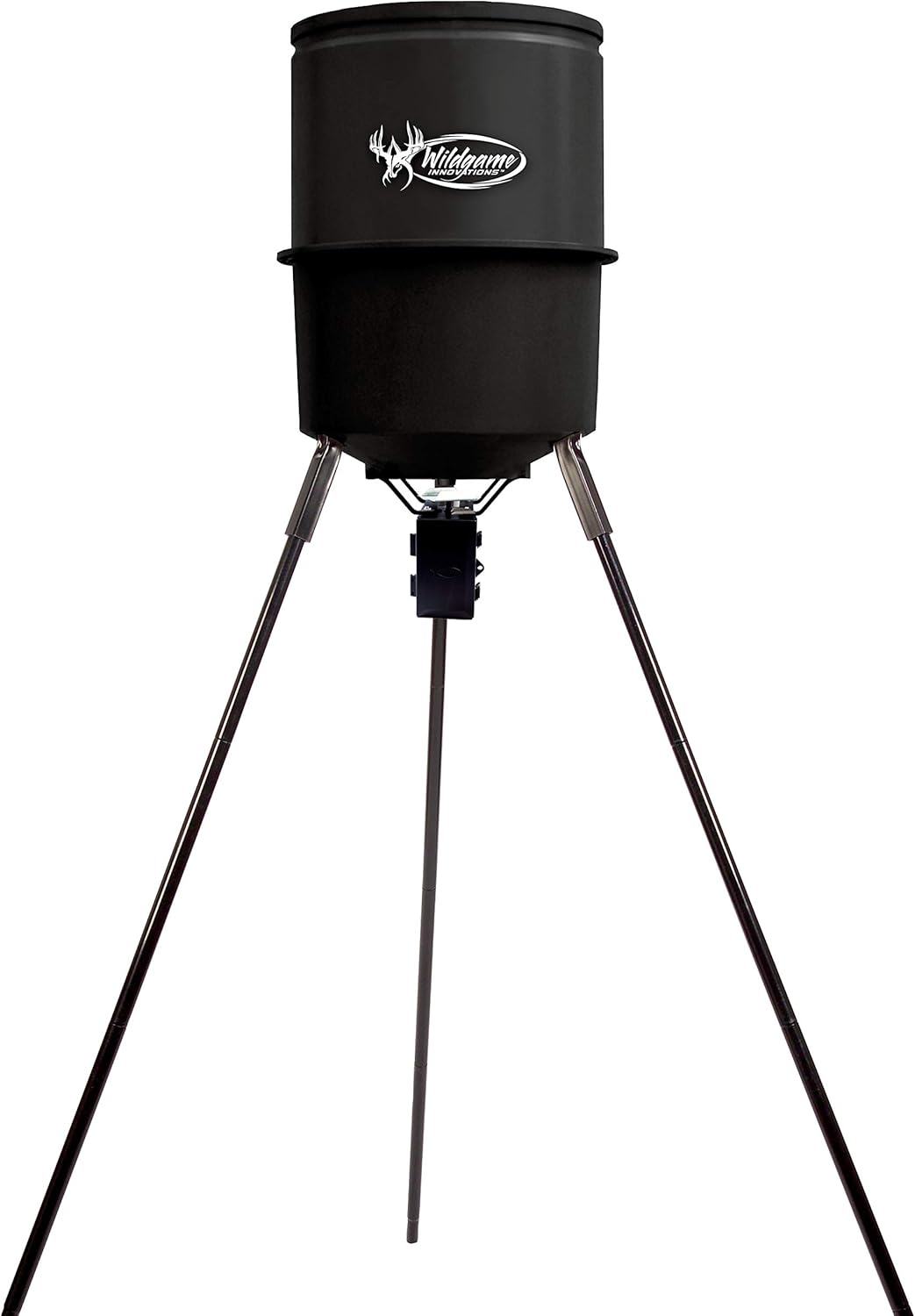
For feeding throughout the season, nothing beats the Wildgame Quick-Set 225, a top-tier timer tripod with a large capacity.As the rut gets going, a little feeder runs dry in a week. When it counts most, this workhorse continues to feed.The first is a freestanding tripod with a drum that can hold 225 pounds; you only need to fill it once to feed it for weeks.Up next: a digital timer that lets you set four separate feed intervals per day, each lasting 5, 10, 15, or 20 seconds.
At last: a galvanized spinner plate with a 30-foot spin radius and heavy-duty coated legs to last all season.Downside: 15–20 minutes required for assembly. There is no rodent protection on the open spinner. Level ground is required for the tripod.The ideal places to plant food plots and manage hunting grounds. Neither tight, wooded settings nor run-and-gun hunters should use this.
4: Boss Buck Gravity Deer Feeder 200 lb

The most effective no-power gravity feeder for efficient feeding is the Boss Buck Gravity 200.Overnight, raccoons can clean up their mess by eating corn tossed from spincast feeders. Every kernel ends up where the deer eat them thanks to gravity.We start with a 200-pound roto-molded barrel on 75-inch galvanized legs. There is no motor, no timer, and nothing that can go wrong with this.
The following is a three-way adjustable flow control system that takes into account the feed rate of corn or pellets through an inner sleeve.Lastly, to reduce waste, feed is gradually dispersed through slow-feed ports that are angled at 10 degrees and have a 1-inch overhang.Not being able to program gravity feeding like a timer is a major drawback. There’s more weight to move and put together. Pile it on top of spincast rig budgets.Ideal for: managers who prioritize protein and waste reduction. Those hunters who prefer to feed at specific times should not use this.
3: Moultrie 200 Lb Deer Feeder Standard

When it comes to app-controlled spincast feeders, the Moultrie 200 Standard is your best bet for hands-free management.Resetting a timer dial requires climbing a ladder, which is both inconvenient and a waste of a hunt. They are both terminated by app control.First, manage the feeding schedule, length, and frequency from your truck using Bluetooth—no need to worry about leaving a scent trail at the feeder.The following is a 30-gallon UV-resistant polymer hopper that can hold 200 pounds—load it from the ground. It has a fill height of 5.5 feet.
Lastly, a broadcast spin plate with cellular reach via an Edge 3 camera allows for up to four programmable feed events per day.Downside: cellular-from-anywhere requires a dedicated Edge 3. The polymer hopper can be easily damaged by rodents. Even now, Spincast sporadically drops feeds.The ideal situation for hunters is one in which they can maintain control of feeders without frightening off deer.Sorry, gravity purists and app haters, this one isn’t for you.
2: Banks Outdoors Feedbank 300 lb

The finest premium set-and-forget feeder with serious capacity is the Banks Outdoors Feedbank 300.Constant refueling wastes time, gas, and invades your hunting territory. The Feedbank reduces the frequency of such journeys.The largest hopper here has a capacity of 300 pounds, so you can fill it up and then forget about it for a few weeks.Following that, rather than using a tripod, it is mounted on a single 8-foot 4×4 post, which allows for unrestricted space for antler growth.
Lastly, there are 42-inch-tall adjustable feed ports with a big watertight cover that keeps maize dry even when it rains.Downside: you won’t get the post or lumber with this. No scheduled feedings are required due to pure gravity. Here, it is the most substantial investment.Apt for: land managers implementing extended feeding programs. People on a tight budget or who want a timed controller shouldn’t buy this.
1: Moultrie Deer Feeder Connected — Cellular 4G LTE

The Moultrie Connected, designed for hunters who manage land they can’t visit daily, is the top deer feeder for 2026.Changing the schedule or checking the corn at any other feeder requires you to drive out. In The Connected, that journey is erased.To start, the app can be accessed nationwide through the built-in 4G LTE. This allows you to make adjustments or start a feed from anywhere in the country.Secondly, before you even think about driving, a Feed Level Detector can measure the real corn level and notify you when to refill.
Thirdly, your phone will immediately receive notifications when there is an issue, such as a clog, jam, or low battery.The fourth feature is a 6-volt solar panel that comes with a 250-pound hopper, which keeps it powered even for the longest stretches.Downside: it requires active cellular data and app configuration. Here, it is the most recent model. Even now, Spincast sporadically drops feeds.Ideal for: hunters in charge of several properties or those in remote areas. Avoid if you’re afraid of being reliant on an app or live off the grid.
Things to Consider Before Buying a Deer Feeder:
Durability and weatherproofing impact your feeder’s lifespan. Opt for materials like heavy-duty plastic or metal that resist rust and corrosion while protecting feed from the elements. This choice ensures your feeder remains functional, regardless of weather conditions.
Capacity and Refill Frequency
Capacity directly affects how often you’ll need to refill the feeder. Larger feeders typically hold more feed, allowing you to spend less time maintaining it. Choose a size that fits your routine.
Selecting the right capacity involves considering feeding habits of deer in your area and how frequently you visit the site. Larger capacities may also deter pests, as feed will not be accessible as often, providing a better experience for the deer.
Varmint and Pest Resistance
Effective pest resistance keeps unwanted animals away from your feeder. Look for designs that include barriers or innovative feeding mechanisms that allow only deer access. This ensures your feed stays safe and available for its intended audience.
Investing in varmint-resistant features can save money on feed and reduce waste. Effective designs often include mechanisms that close off access when non-target animals attempt to reach the food, ensuring that only deer benefit from your efforts.
Advantages for Herd Management and Observation
Supplemental feeding offers excellent benefits for monitoring deer behavior and health. You can closely observe herd dynamics and track physical conditions, enhancing your overall management strategy. This practice also allows for improved nutritional balance, leading to healthier animals that are more resilient to challenges.
Challenges Regarding Disease and Dependency
Feeding can lead to dependency on artificial sources, altering natural foraging behaviors. This reliance may also contribute to overcrowding and facilitate the spread of diseases among deer.
Dependency on supplemental feeding can weaken natural instincts, making deer less adaptive to environmental changes. Over time, this alteration may create vulnerabilities, leading to population issues if feeding stops. Additionally, crowded feeding areas can increase stress and disease transmission, such as Chronic Wasting Disease (CWD), complicating herd management efforts.
Site Selection and Strategic Placement
Choosing an ideal site enhances deer visitation and feeding. Look for open areas near water sources or natural food paths. Avoid placing the feeder too close to human activity to maintain deer comfort.
Assembly and Secure Mounting
Follow the provided assembly instructions to build your deer feeder accurately. Verify all components are tightly secured in place to ensure stability and longevity of the feeder.
Secure mounting is necessary for preventing the feeder from being knocked over by wind or deer. Use sturdy anchors or brackets, especially in areas prone to high winds or heavy foot traffic. Consistent checks will ensure all parts remain intact.
Programming Distribution Schedules
Setting up distribution schedules allows you to control feeding times and amounts efficiently. Adjust the timer based on deer activity patterns in your area for the best results.
Adjusting the distribution schedule is key to attracting deer when they are most active. Monitor local deer activity and modify feeding times accordingly, ensuring they have access to food during early mornings or late evenings when they feel safest.
Sanitation Protocols for Disease Prevention
Implementing sanitation protocols minimizes disease risk. Regularly clean feeders, tools, and surrounding areas. Dispose of spoiled feed promptly and sanitize surfaces to stop the spread of pathogens. Any lapse in these practices can lead to serious health issues among deer populations.
Battery and Component Longevity
Managing battery life is important for uninterrupted operation. Use high-quality batteries and periodically check connections for corrosion. Any failure to maintain these components can result in unexpected breakdowns, affecting feeding schedules.
Investing time in battery and component maintenance pays off. Monitor batteries every few months for performance. Clean terminals to prevent power loss and replace components showing signs of wear. This proactive approach ensures your feeder remains reliable throughout the feeding season.
Optimal Feed Selection for Regional Needs
Selecting the right feed is key for attracting deer in your area. Research local deer preferences and nutritional needs. Any mismatch in feed can deter deer, reducing your efforts’ effectiveness.
Choosing appropriate feed involves understanding your deer population’s dietary requirements. Local factors, such as vegetation and seasonal changes, can influence preferences. Tailoring your feed selection to these needs helps maximize your deer attraction strategy while promoting healthy growth and development for the animals.
State and Local Baiting Regulations
Each region has its own rules regarding baiting animals, including deer. Research your state and county regulations to ensure you are in compliance, as penalties for violations can be severe.
Maintaining Natural Foraging Balance
Sustaining a natural foraging balance is important for the ecological health of deer populations. Over-reliance on feeders can disrupt their instincts and lead to dependence on artificial food sources.
Consider the impact of excessive feeding on deer behavior and health. When deer become reliant on feeders, they may neglect their natural foraging habits, which can reduce their ability to find food in the wild. Diversifying their diet through natural foraging is important for maintaining healthy populations and ecosystems, promoting overall deer vitality. Aim to use feeders as a supplemental source rather than the primary food source, ensuring deer remain connected to their natural behaviors and environmental cues.
Final Words
To wrap up, consider your specific needs, budget, and the feeding habits of deer in your area before investing in a deer feeder. Analyze the types available, their capacities, and durability. A well-chosen feeder can enhance your hunting experience significantly, ensuring you’re prepared for successful outings.
Leave a Reply