
Best Duck Hunting Waders can make the difference between a cold, wet day and a successful hunt. If leaks, numb toes, or heavy gear ruin your season, our field-tested picks deliver waterproof, insulated comfort and silent movement. These proven waders offer unbeatable warmth, fit, and confidence so you hunt longer and smarter. Ready for gear that truly performs? Read on to find the perfect pair for your next outing.
Contents
- Top 7 Duck Hunting Waders:
- 7: FISHINGSIR Chest Waders with Boots
- 6: Foxelli 4mm Neoprene Chest Waders
- 5: Trudave 4.0mm Neoprene Chest Waders
- 4: HISEA 800G Insulated Neoprene Chest Waders
- 3: FROGG TOGGS Amphib Neoprene Bootfoot Chest Wader
- 2: 8 Fans 1000G Insulated Neoprene Chest Waders
- 1: FROGG TOGGS Grand Refuge 2.0 Insulated Chest Wader
- Things to Consider Before Buying a Duck Hunting Wader:
- Neoprene Models for Cold Weather Insulation
- Breathable Fabrics for High-Activity Hunting
- Insulation Ratings and Thermal Efficiency
- Material Durability and Seam Construction
- Boot-Foot vs. Stocking-Foot Versatility
- Chest-High vs. Waist-High Coverage
- Identifying and Repairing Punctures
- Final Words
Top 7 Duck Hunting Waders:
7: FISHINGSIR Chest Waders with Boots

The most cost-effective option for early season hunting—the FISHINGSIR Chest Waders.There will be warm weather and shallow water on opening weekend. With insulated neoprene, you’ll stay warm even before takeoff.First, the upper is a 2-ply nylon/PVC improvement that is knitted more denser than regular nylon. Slender, not weak.The next step is to seal the two most common points of entry for inexpensive waders during production: the welded boot attachments and the taped seams.
Last but not least: H-back suspenders with quick-release buckles that clip off at the vehicle and cleated rubber soles.Negatives: No insulation means you’ll get wet very quickly. Barbed wire is punctured by the PVC top. All the way across the leg, there is a generous slash.Perfect for: early-season hunters, flooded fields, and tiny ponds. Not recommended for: use in the dead of winter or on thick, prickly vegetation.
6: Foxelli 4mm Neoprene Chest Waders

For hunters who start their day on their knees, the Foxelli 4mm Neoprene is the ideal initial investment.Where thin PVC waders tear and quit are when setting decoys, brushing a blind, or kneeling in a layout.To start, it has 4mm neoprene all over, which is actual cold-water insulation and has enough give to allow for movement.Then there are the reinforced knee pads in the legs, which are the first to wear out on inexpensive waders.
Lastly, there is a chest pocket that can be used as a hand warmer in addition to the double-stitched, taped, and sealed seams.Downside: the PVC boots have thin linings, so your feet will get chilly before the rest of you. Far too hot to go for a walk in the spring. Sizing for boots is narrow.Ideal for: mid-season marsh hunting, blind construction, and decoy setting. Avoid at all costs: hunters braving the cold water.
5: Trudave 4.0mm Neoprene Chest Waders

For hunters who have a long trek in, the ideal choice is the Trudave 4.0mm Neoprene.You have to earn your way to public spaces on foot. The hunt’s most taxing aspect becomes the trek in, thanks to the heavy boots.To start, choose a pair of breathable, lightweight PVC boots; this will make them easier to drag out of the muck.Next, a removable insole that you can pull out to dry overnight or replace with a thicker one when the weather turns chilly.
Coated legs made of 4.0 mm neoprene with stitched, bonded, and taped seams: the finishing touch.Downside: you won’t be able to use these boots as a January wader because they don’t have any substantial insulation. Reviewers have noted a thin sole on top of jagged gravel. Sizing is generous.Ideal conditions: moderate cold, public land, and walk-in hunters. Avoid doing things like sitting motionless in cold water.
4: HISEA 800G Insulated Neoprene Chest Waders

The HISEA 800G Insulated is the most cost-effective option for cold standing water in terms of heat output.Much after your feet have given out, your core remains toasty. Boots are the usual starting point for wader issues.To start, the rubber boots with 800-gram Thinsulate—the largest single heat jump at this level.The next step is a 4.5 mm layer of neoprene laminated over a nylon jersey, with seams treated to prevent water entry.
A quick-drain hand-warmer pocket with an internal dry pocket and eight shell loops round out the set. Tailored for the hunt.Drawbacks: feels heavy when wet and is a great pain to walk in. Many customers have mentioned that the size runs big in the chest. You have to break in the boots.Ideal for: cold mornings in the marsh, standing hunts, and hunters whose feet give out first. Forget about hot weather and lengthy walks.
3: FROGG TOGGS Amphib Neoprene Bootfoot Chest Wader

If you’re fishing in water up to your chest, you need the FROGG TOGGS Amphib.Where ordinary waders fall short is in deep water. A misstep sends water rushing up the back.To start, a high-back design that’s ideal for deep-water swimming provides extra protection at the back, where the water rises first.The next step is a pair of wool felt-soled, 600-gram Thinsulate boots; felt prevents heat from radiating from damp soil.
Lastly, there is a zipped security pocket and two D-rings, as well as three layers of triple-stitched, bonded, and taped premium neoprene.Negatives: cumbersome, difficult to dry in between hunts. Wearing thick socks will make the boots run narrow. Size affects the availability of camouflage.These areas are ideal for big-water hunters, deep sloughs, and flooded woods. Avoid: hunters who prefer to remain knee-deep.
2: 8 Fans 1000G Insulated Neoprene Chest Waders
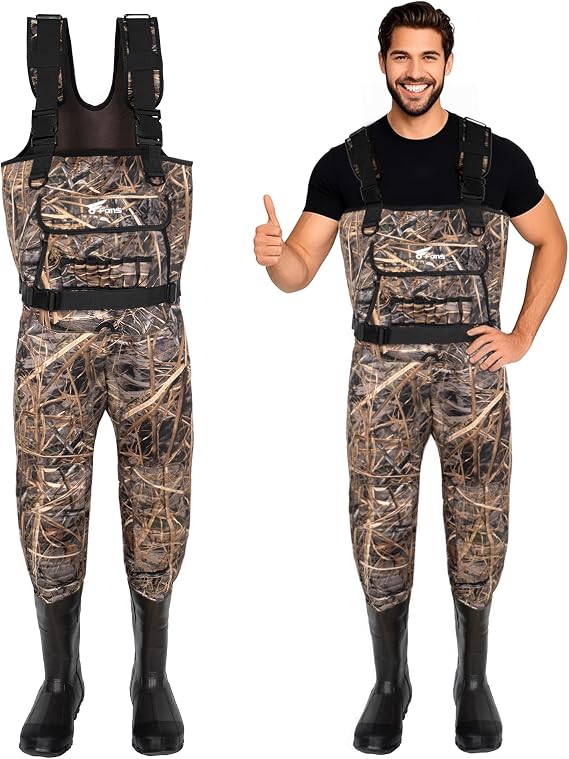
If you want to remain still when the marsh becomes cold, the 8 Fans 1000G are your best bet.Slow hunters will be punished in the late season. You’re waiting for a single flight while standing in frigid water.To start, we have the warmest footwear on our list: 1000-gram Thinsulate boots. After all, the feet are where the victory is won in the late season.After that, we have the thickest upper here, made of 5mm neoprene, which has a polyurethane covering, heat-sealed strips, and blind-stitched bonded seams.
Lastly, these shoes include a deep tread that traps soft, sucking mud and a strengthened vamp that protects against punctures.Downside: you’ll become too hot just walking in, so it’s not practical for anything else than true cold. The 5mm construction limits mobility. Far too heavy to carry.Layout hunters, late-season blind sitters, and wetlands with a frozen edge are the best places to go. Not recommended for: pre-season or extended hikes.
1: FROGG TOGGS Grand Refuge 2.0 Insulated Chest Wader

The FROGG TOGGS Grand Refuge 2.0 is the best duck hunting wader because it’s the only pair here that changes with the seasons.The other waders on our list force you to choose between two extremes in temperature: either you’ll be cooking in October or freezing in January.To start, the shell is interchangeable between a heated wader and a light wader thanks to the 120-gram Insul-Lite lining that zips in and out. Just just one thing accomplishes that.Second, the walk-in won’t drench you from the inside thanks to the Teflon DWR coating on the polyester shell, which is both waterproof and breathable.
Third on the list are cleated-outsole Thinsulate boots weighing 1,200 grams, which provide the most insulation of any boot here (second only to number two).A heavy-duty polyester upper with reinforced zones at the knee and shin is the fourth feature.The most costly option here is a drawback. In dense underbrush, breathable shells are more likely to puncture than neoprene. Zipping the liner in the dark requires practice.Optimal for: hunters that venture out on the first day of the season through the ice. Avoid: weekend hunters.
Things to Consider Before Buying a Duck Hunting Wader:
You need to evaluate several important factors before purchasing a duck hunting wader. Comfort, insulation, material, and fit can significantly impact your experience in the field. Making an informed decision can enhance both your safety and enjoyment during your hunting trips.
Neoprene Models for Cold Weather Insulation
Neoprene waders offer excellent insulation, making them ideal for cold weather conditions. Typically 3mm to 5mm thick, these waders keep you warm even in frigid waters. Their durability adds a layer of protection against punctures and abrasions when navigating through challenging terrain.
Breathable Fabrics for High-Activity Hunting
Breathable fabric waders are perfect for hunters who engage in active pursuits. Advanced materials allow moisture to escape while preventing water from entering, ensuring comfort during long days in the field. This feature keeps the wearer dry and comfortable even in fluctuating temperatures.
Breathable waders come with various insulation levels, appealing to hunters in milder climates. Lightweight options are available, allowing for easy movement without sacrificing durability. Renowned brands often incorporate mesh linings and adjustable features, increasing customizability for high-energy activities. Consider your specific hunting style to select the best match for your needs.
Insulation Ratings and Thermal Efficiency
Evaluating insulation ratings assists in ensuring thermal efficiency. Waders with appropriate insulation reduce the risk of hypothermia during cold weather. High-quality materials like neoprene can deliver the warmth necessary for long hours in freezing temperatures.
Material Durability and Seam Construction
Assessing material durability is necessary for longevity. Sturdy fabrics, such as nylon or polyester blends, withstand abrasions from rough terrains. Pay attention to seam construction as well, as reinforced seams minimize leakage and enhance overall reliability.
Wader materials significantly impact performance and comfort in the field. Fabrics crafted for durability can withstand the rigors of duck hunting, such as muddy conditions and sharp vegetation. While investing in quality seams, opt for welded or double-stitched designs that enhance waterproofing. Such attention to detail not only improves function but also extends the life of your waders, keeping them reliable season after season.
Boot-Foot vs. Stocking-Foot Versatility
Choosing between boot-foot and stocking-foot waders depends largely on your hunting environment. Boot-foot waders provide integrated boots, making them convenient for quick deployment. Stocking-foot waders, however, allow for the flexibility of pairing with various boot styles, offering more options for traction and comfort in challenging terrains.
Chest-High vs. Waist-High Coverage
Chest-high waders provide maximum coverage, ideal for deeper water scenarios. Waist-high options are suitable for shallower environments, allowing for easier movement and mobility. Preference often boils down to personal comfort and hunting habits; assess your typical hunting conditions for the best fit.
Comparing chest-high and waist-high waders reveals distinct advantages tied to coverage and mobility. Chest-high models protect against sudden water depth changes, making them perfect for wetlands and rivers. In contrast, waist-high waders promote agility, making it easier to navigate marshlands or areas with light water exposure. A decision should reflect your specific hunting style and typical conditions encountered.
Identifying and Repairing Punctures
Finding punctures quickly can save your waders from further damage. Regular inspections after hunting trips allow for early detection. Marking any holes with a small piece of tape can aid in locating them for repairs.
Repairing punctures can be accomplished using different methods, depending on the material of your waders. Neoprene waders may require specialized adhesives, while nylon models often can be patched with repair tape. When applying repairs, ensure the area is clean and dry for best adhesion. Allow the adhesive to cure fully before exposing the waders to water again. Regularly checking the integrity of these repairs contributes to lasting durability.
Final Words
Choosing the right duck hunting wader requires careful consideration of fit, material, and design features. Prioritize comfort and functionality to ensure an enjoyable hunting experience. Understanding your specific needs, such as climate and water conditions, will lead to more informed decisions, ultimately enhancing your time in the field.
Leave a Reply