
Finding the best emergency survival kits shouldn’t be stressful when your family’s safety is on the line. Disasters strike without warning, and feeling helpless during a crisis is terrifying. We have tested the top disaster preparedness gear to give you total peace of mind. Our guide helps you pick a reliable bug out bag with life-saving tools. Let’s explore the best options to keep you ready.
Contents
- Top 7 Emergency Survival Kits:
- 7: Ready America 72 Hour Emergency Kit, 1-Person
- 6: Ready America 72 Hour Emergency Kit, 2-Person
- 5: EVERLIT 250 Pieces Survival First Aid Kit IFAK
- 4: Survival Kit 250Pcs with Molle System and Tent
- 3: Ready America 72 Hour Deluxe Emergency Kit, 1-Person
- 2: Everlit Survival Car Emergency Kit
- 1: EVERLIT Complete 72 Hours Earthquake Bug Out Bag
- Things to Consider Before Buying a Emergency Survival Kit:
- Mobile Bug-Out Bags vs. Stationary Home Kits
- Vehicle-Specific and Workplace Emergency Sets
- Prioritizing Water, Food, and Medical Supplies
- Assessing Tool Durability and Brand Reliability
- Strategic Organization for High-Stress Access
- Weight Distribution and Ergonomic Considerations
- Establishing a Rotation Schedule for Consumables
- Routine Testing of Electronic and Mechanical Gear
- Final Words
Top 7 Emergency Survival Kits:
7: Ready America 72 Hour Emergency Kit, 1-Person

This is the greatest ultra-budget emergency preparedness kit for first-timers, the Ready America Emergency Kit.Having a flashlight and hoping for the best is most people’s backup plan in an emergency. That is not a viable option when the power is down for three days.The Emergency Kit addresses this by providing a 72-hour survival kit stocked with items recommended by the Red Cross. No cooking for one person for three days.
Following this, you will find six airtight water containers that have been approved by the Coast Guard. These containers are leak-proof and do not require rotation.At last: a 33-item first aid pack that includes bandages, antiseptics, and the essentials for treating minor injuries in the event that no clinic is open.Detriment: only fits one person; couples will require two bags. Basic first aid is a must. This is food, not a meal plan.Ideal for: beginning preppers, single renters, and anyone else with no experience. Not suitable for households with more than two people.
6: Ready America 72 Hour Emergency Kit, 2-Person

The Ready America Emergency Kit is the greatest 72-hour bag for two people on a budget.When you only have one person using a solo kit, you end up with only half of the food and water that you need.All of the necessities are doubled in the emergency kit. Get this: two 2400 calorie meal bars—that’s one person’s daily ration—and they’ll last for five years. Up next: water pouches for the Coast Guard that are airtight and do not require rotation.
As a last item, two adults will be adequately covered from the rain and kept warm with the emergency blankets and ponchos.Downside: the standard 33-piece first aid pack is sufficient for treating minor injuries. Neither a flashlight nor a firestarter are supplied. A simple backpack.Apt for: frugal couples and small families. Avoid if you are a single prepper or a family of three or more.
5: EVERLIT 250 Pieces Survival First Aid Kit IFAK

The EVERLIT 250 IFAK is an excellent medical kit for dealing with trauma that can be added to any survival gear.First aid is often neglected by all-in-one kits. No amount of bandages and ointment will be able to stop severe bleeding or close a deep wound.In cases where bandages are insufficient, the EVERLIT 250 should be considered.The first line of defense against serious bleeding is trauma equipment developed by veterans. This includes tourniquets, pressure dressings, and hemostatic gauze.
Now for the two-pound Molle EMT pouch—which may be attached to a belt, a vehicle headrest, or a backpack—comes next.Finally, medical expertise that goes well beyond the band-aid and ointment kits, meeting or exceeding OSHA workplace standards.Drawbacks: only used for medical purposes; does not include food, water, or shelter. Untrained hands should not use tourniquets because of the potential dangers they pose.Who it’s best for: Those who have a survival kit but are looking to upgrade their medical supplies. Those just starting out should not purchase this set.
4: Survival Kit 250Pcs with Molle System and Tent
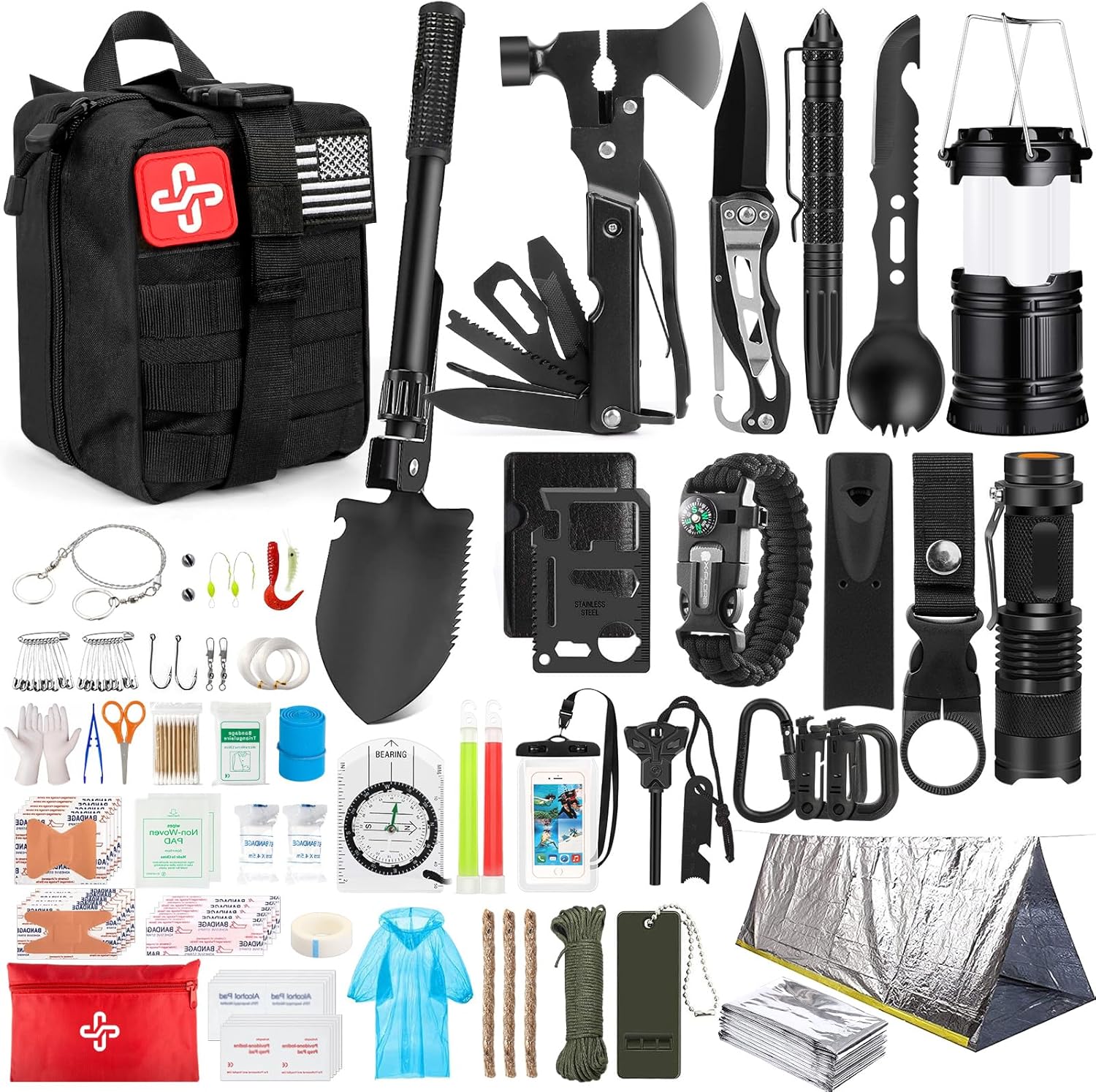
The finest mid-range kit with a built-in emergency shelter is the 250-piece Molle Survival Kit.There is no place to sleep in a basic kit, but there is food and drink. Even in the darkest of storms, a mylar blanket won’t keep you warm.A genuine emergency tent and survival gear are complete with the 250Pcs.To start, a mylar emergency tent—it can be folded up and stored in a small pocket, but when unfolded, it provides a sturdy place to stay dry and protected from the elements the night before.
Effortlessly attach it to any tactical pack, this 1000D water-resistant Molle EMT bag is designed to withstand outdoor punishment.A well-organized loadout that includes a first aid kit, fire starter, signaling device, and blade is the last piece of the survival puzzle.Negative: you’ll need to provide your own food and drink. Not a true camping tent, but a mylar emergency cover.Those who go camping, hiking, or prepping usually bring their own food and water. Inappropriate for: those seeking a single grab-and-go bag.
3: Ready America 72 Hour Deluxe Emergency Kit, 1-Person

When it comes to solo kits with built-in electricity for outages, the Ready America Deluxe 1-Person is the finest option.Within hours of a grid outage, your phone will stop working. Missing navigational aid, power outage, and means of communicating with loved ones via text message.When all else fails, the Deluxe’s built-in power station ensures that your devices will continue to function.When the power goes out, you can still use your phone, flashlight, and radio thanks to the built-in portable power station.The public-health component, which is typically missing from kits, is followed by a 33-piece first aid kit, hygiene kit, masks, and thermometer.
At long last: water and food that have been authorized by the Coast Guard—the same long-lasting supplies found in survival kits for sailors.Con: The power station is on the tiny side, thus it can only handle small electronics like phones and radios, not big appliances.Perfect for a single person; couples require two. Not as light as Ready America’s base.Ideal for: individuals who prefer to prepare on their own and are concerned about power outages. People that require more supplies, such as couples or families, should not purchase this.
2: Everlit Survival Car Emergency Kit
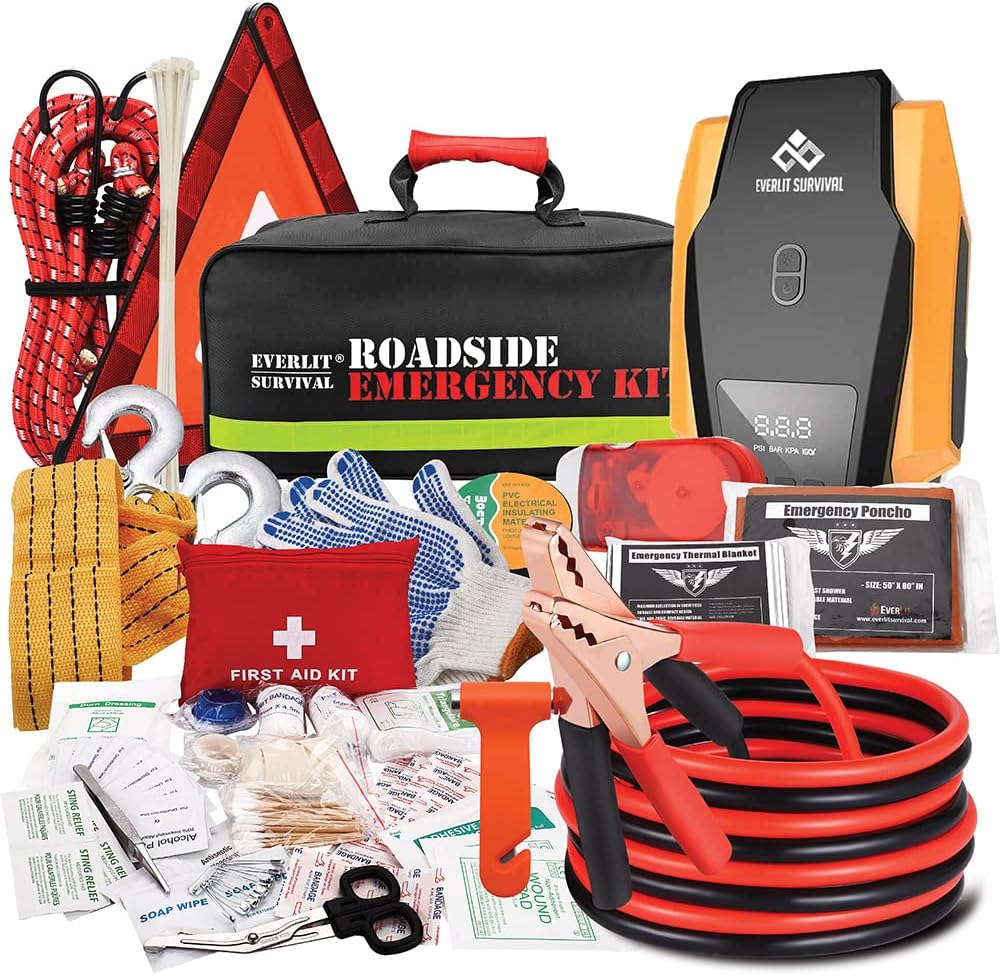
In the event of a catastrophe that all other emergency kits fail to address, the Everlit Car Emergency Kit is the ideal choice.If you’re not at home, no kit will work. The majority of catastrophic events, such as a dead battery, a blizzard, or a flat tire, leave individuals stranded on the road.For those times when your vehicle is a total loss, there is the Car Kit.To start, there’s a digital tire inflator that doubles as an air compressor, so you can self-inflate a flat or fill a leak.Step two: a 12-foot set of jumper wires and a tow strap in case your battery dies or if you need to liberate a stuck vehicle without a helper.
Last but not least: a roadside first aid kit, a flashlight, and sturdy gloves; you won’t need them to fix anything in the dark or cold.Downside: nobody’s talking about necessities like food, water, or shelter; it’s car-centric solely. Hours stranded, not days—not a 72-hour kit. A vehicle’s engine is required to operate an air compressor.Approved for: Commuters, families doing road trips, and drivers whose primary concern is the road. Do not use for: bug-out or shelter-in-place scenarios.
1: EVERLIT Complete 72 Hours Earthquake Bug Out Bag

An all-inclusive 72-hour bug-out kit for families—the EVERLIT STORM II.Hour fifty is when most family kits sell out. It’s more like a state of panic than 72 hours of preparation.Two individuals can be safely transported by STORM II for 72 hours, according to FEMA’s description. First, hydration for two to seventy-two hours, as permitted by the Coast Guard, in twenty-four sealed packets. The second item is a pair of 3,600-calorie meal bars—which, without cooking, satisfy FEMA’s 1,000-calorie daily recommendation.A third option is water filtration tablets, which can convert untreated water from rivers or rainstorms into potable water in an emergency.
The fourth item is a sturdy tactical backpack that can accommodate two people with ease and is MOLLE-compatible for additional accessories.Bad: this is the priciest kit available. Unlike delicate fashion, tactical style draws attention. Just enough for two people; larger families may require an additional bag.These bags are ideal for families who just desire one and live in areas prone to earthquakes or wildfires. Not suitable for: living on a shoestring or going it alone.
Things to Consider Before Buying a Emergency Survival Kit:
Most individuals overlook crucial aspects when purchasing an emergency survival kit. Assess your specific needs, local hazards, and the kit’s contents to ensure it meets your expectations. Make informed choices to enhance your preparedness for unexpected situations.
Mobile Bug-Out Bags vs. Stationary Home Kits
Mobile bug-out bags are designed for convenience when you need to evacuate. Stationary home kits focus on sustaining you in place during emergencies. Deciding between them depends on your lifestyle and potential threats.
Vehicle-Specific and Workplace Emergency Sets
Vehicle-specific kits cater to roadside emergencies, while workplace sets prepare you for in-office incidents. Both should include items tailored for your routine and location. Vehicle-specific kits often include jumper cables, first-aid supplies, and water, prepared for unexpected breakdowns or accidents. Workplace sets should address common emergencies like power outages or medical needs, ensuring you can respond effectively in your daily environment.
Prioritizing Water, Food, and Medical Supplies
Start by focusing on important items: water for hydration, food for energy, and medical supplies for health. Ensure your kit includes a reliable water source, non-perishable food, and basic first-aid equipment to address potential emergencies effectively.
Assessing Tool Durability and Brand Reliability
Evaluate tools based on their materials and user feedback. Sturdy, well-reviewed brands are more likely to provide long-lasting products that can withstand demanding conditions during emergencies.
Choosing durable tools is important for ensuring they perform when needed. Research materials that resist wear and impact, and lean toward brands with proven track records. Checking customer reviews can uncover common issues, helping you avoid unreliable products that may fail during critical moments.
Strategic Organization for High-Stress Access
Prioritize easy access by grouping similar items together. Place frequently used supplies, like first aid and water, near the top or in designated exterior pockets. This reduces time spent searching during emergencies, allowing you to focus on urgent needs.
Weight Distribution and Ergonomic Considerations
Properly distributing weight in your kit enhances portability and comfort. Place heavier items at the bottom and closer to your back to maintain balance. This strategy minimizes fatigue, especially during prolonged use. Incorporating ergonomic design also helps prevent strain. Adjustable straps and padding offer personalized comfort, catering to various body types. A well-balanced pack not only eases the physical burden but also improves mobility, ensuring you can move swiftly and efficiently when needed.
Establishing a Rotation Schedule for Consumables
Create a timeline for replacing consumable items, such as food and medicine. A scheduled rotation helps maintain freshness and efficacy. Set specific reminders based on shelf life to avoid using outdated supplies during an emergency.
Routine Testing of Electronic and Mechanical Gear
Testing your gear on a regular basis prevents unforeseen failures. Check batteries, flashlights, and any communication devices periodically, ensuring full functionality during critical moments.
Conduct tests for each electronic and mechanical item in your kit at least every six months. Turn on flashlights to confirm they illuminate properly, check communication devices for battery life, and ensure that tools function effectively. Document any repairs or replacements needed to maintain an organized approach to gear reliability.
Final Words
On the whole, selecting an emergency survival kit requires careful evaluation of your specific needs, the types of emergencies you may face, and the kit’s contents. Assess factors such as the number of people covered, duration of supplies, and ease of use. Making informed choices ensures you are better prepared for unexpected situations.
Leave a Reply