
Best Kayak Carts make hauling heavy boats simple and protect your back-perfect if you dread long carries, rough sand, or tricky launches. In this expert-reviewed guide, I test rugged kayak trolleys and lightweight kayak dollies to find reliable, portable options that save time and effort. You’ll love the freedom and confidence these game-changing carts bring to every trip. Read on to discover top picks and smart buying tips.
Contents
- Top 7 Kayak Carts:
- 7: VEVOR Kayak Cart, 280lbs Load Capacity, 10 Inch Solid Tires
- 6: Bonnlo Kayak Cart Canoe Dolly with NO-Flat Airless Tires and 2 Ratchet Straps
- 5: Ulticor Kayak Cart, Puncture-Free Wheels, No Tools Required
- 4: Bonnlo Kayak Cart, Heavy Duty Universal, 12″ Flat-Free Wheels, 450 Lb Capacity
- 3: Suspenz All-Terrain Kayak Cart Dolly, Super Duty, Model 22-9908
- 2: Bonnlo Kayak Cart with 12″ Big Beach Balloon Wheels and Free Pump
- 1: Wilderness Systems Heavy Duty Kayak Cart
- Things to Consider Before Buying a Kayak Cart:
- Weight Capacity and Vessel Dimensions
- Terrain Compatibility and Ground Clearance
- Scupper Carts vs. Platform Designs
- Plug-In vs. Universal Strap-Over Models
- Identifying the Optimal Balance Point
- Mastering Tie-Down and Cam Strap Techniques
- Preventing Corrosion in Saltwater Environments
- Proper Cleaning and Storage Procedures
- Final Words
Top 7 Kayak Carts:
7: VEVOR Kayak Cart, 280lbs Load Capacity, 10 Inch Solid Tires

The most cost-effective option for sit-on-top kayaks is the VEVOR 280-pound cart.Because a cart is considered superfluous, many paddlers choose to drag their boat instead. That concludes it.To begin, your scupper holes will be filled with two posts. No need to thread any straps; simply lift the stern, slide it on, and step on.Proceed to the following section: solid no-flat wheels measuring 10 inches. On a bumpy ramp, there is nothing to inflate or puncture.
Last but not least: a 280-pound-rated, 2-millimeter-thick aluminum frame with hull-protecting drain-hole shields.Kayaks do not accommodate sit-inside boats or canoes because they require drain holes that are one inch or wider. Requires no kickstand. Wheels become bogged down in fine sand.On level surfaces and ramps, sit-on-top owners will get the best service. Avoid on canoes and in areas with soft sand.
6: Bonnlo Kayak Cart Canoe Dolly with NO-Flat Airless Tires and 2 Ratchet Straps
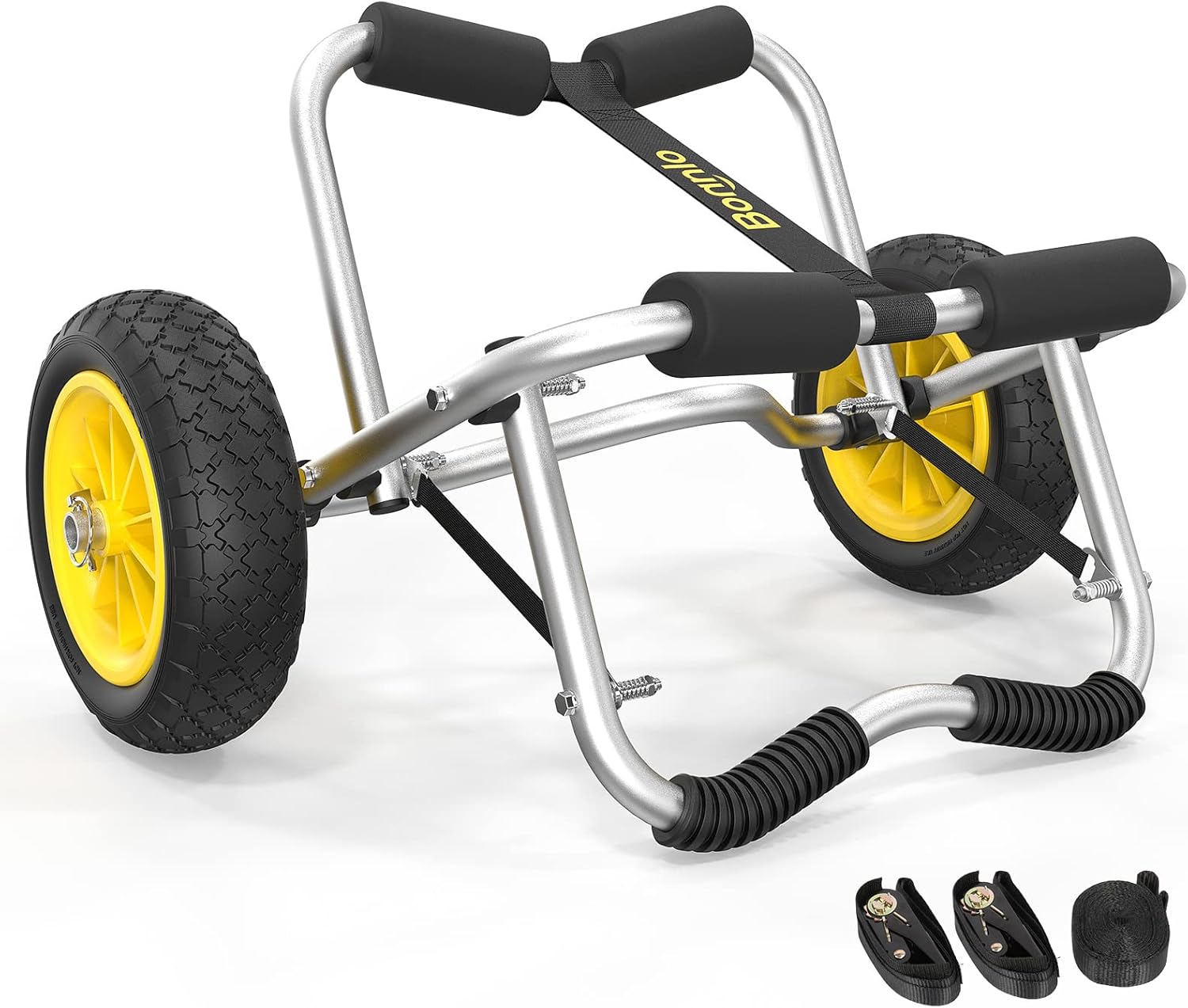
For boats lacking scupper holes, the finest affordable all-arounder is the Bonnlo airless-tire cart.There ought to be drain holes in half of those carts. You won’t find them on any canoe, but there are plenty of kayaks.To begin with, rather than being plugged in, it is strapped over the top. You can secure any type of hull—sit-inside, sit-on-top, canoe, or paddleboard—with two ratchet straps.After that, solid polyurethane tires measuring 10 inches by 3 inches. The load is evenly distributed across grass and gravel with a three-inch contact patch.
Lastly, a trunk-sized, anodized aluminum frame.The lowest ceiling here is 200 pounds, which is a drawback. Strap threading is more time-consuming than post dropping. Even in fine sand, it has difficulty moving.Ideal for: mixed fleets, sit-inside kayaks, and canoes. Avoid using it on beaches or with heavy fishing gear.
5: Ulticor Kayak Cart, Puncture-Free Wheels, No Tools Required

When it comes to saltwater launches and small trunks, the Ulticor kayak cart is your best bet.After a certain number of salt excursions, metal carts rust, and a trunk can be consumed by a stiff frame.For starters, you don’t need any special tools to disassemble it; once you do, it reassembles perfectly. It has a hatch for storage.The next step is a composite body with reinforcements and stainless steel axles, so there is very little that salt water can damage.
At last, a snap-and-lock kickstand keeps the frame from sagging as you load up your 260-pound boat all by yourself.Downside: when subjected to stress, composites bend more than aluminum. The all-terrain picks have larger wheels. The joints wear out with repeated assembly.This product is ideal for those who paddle on saltwater, have small vehicles, or have limited space for storage. Warning: not recommended for use in extremely deep sand or with maximum carrying loads.
4: Bonnlo Kayak Cart, Heavy Duty Universal, 12″ Flat-Free Wheels, 450 Lb Capacity

The most cost-effective option for a fully-equipped fishing kayak is the Bonnlo heavy-duty universal.Three hundred pounds is a lot for a fishing kayak to carry about with a battery, cooler, and gear. Carts on a budget unfold.To start, there is actual headroom, with a rated capacity of 450 pounds on marine-grade heat-treated aluminum bunker bars.After that, you can change the width between 6.3 and 18.7 inches by adjusting the number you specified once against the printed lines on the axle.
Last but not least: a kickstand to keep the frame upright when you’re loading it alone and 12-inch wheels that won’t flatten.Cons: it’s heavy enough that carrying it back is a real challenge. It is necessary to have space under narrow hulls for wide bunker bars.Fishing kayaks, tandem boats, and boats with big cargoes are the best. Avoid if you’re a minimalist or have a light hull.
3: Suspenz All-Terrain Kayak Cart Dolly, Super Duty, Model 22-9908

When it comes to launches that require some effort, nothing beats the Suspenz All-Terrain Super Duty cart.A hundred yards of broken terrain or a rock climb await some put-ins. The little wheels come to a complete halt.Start with the largest here, 15-inch airless wheels. Big wheels don’t halt at impediments; they roll right over them.The cradle is then modified in five different ways to accommodate V-shaped, tunnel, catamaran, and flat-bottom hulls. Get them up off the ground.
Lastly, the boat is secured by two sets of cam-buckle straps, and it has a powder-coated steel frame that can support 350 pounds.Drawbacks: The steel construction makes it the heaviest cart in its category. Space is at a premium for those wheels. It takes more time to set up.Ideal for: unpaved roads, rocky beaches, and out-of-the-way put-ins. Avoid using on: paved ramps or narrow tree trunks.
2: Bonnlo Kayak Cart with 12″ Big Beach Balloon Wheels and Free Pump

If you want to launch your beach balloon from a soft surface, the Bonnlo cart is your best bet.On this list, every single hard wheel has had at least one failure. A trench is dug when it hits dry sand.Our first item is a set of low-pressure balloon wheels 12. When you run them gently, they will spread the load out rather than cutting into the surface.After that, you’ll find a hand pump in the package; use it to lower the pressure for the beach and then raise it for the lot.
At last: a 300-pound-rated aluminum frame measuring 22 by 3 millimeters; two ratchet straps; yet it still folds for storage.Con: You won’t have much room in your trunk for the balloon wheels. Pressure should be checked. Pavement makes them roll more heavily.Ideal for flat coastal areas, dune crossings, and beach launches. Avoid: paved ramps and confined spaces for storage.
1: Wilderness Systems Heavy Duty Kayak Cart
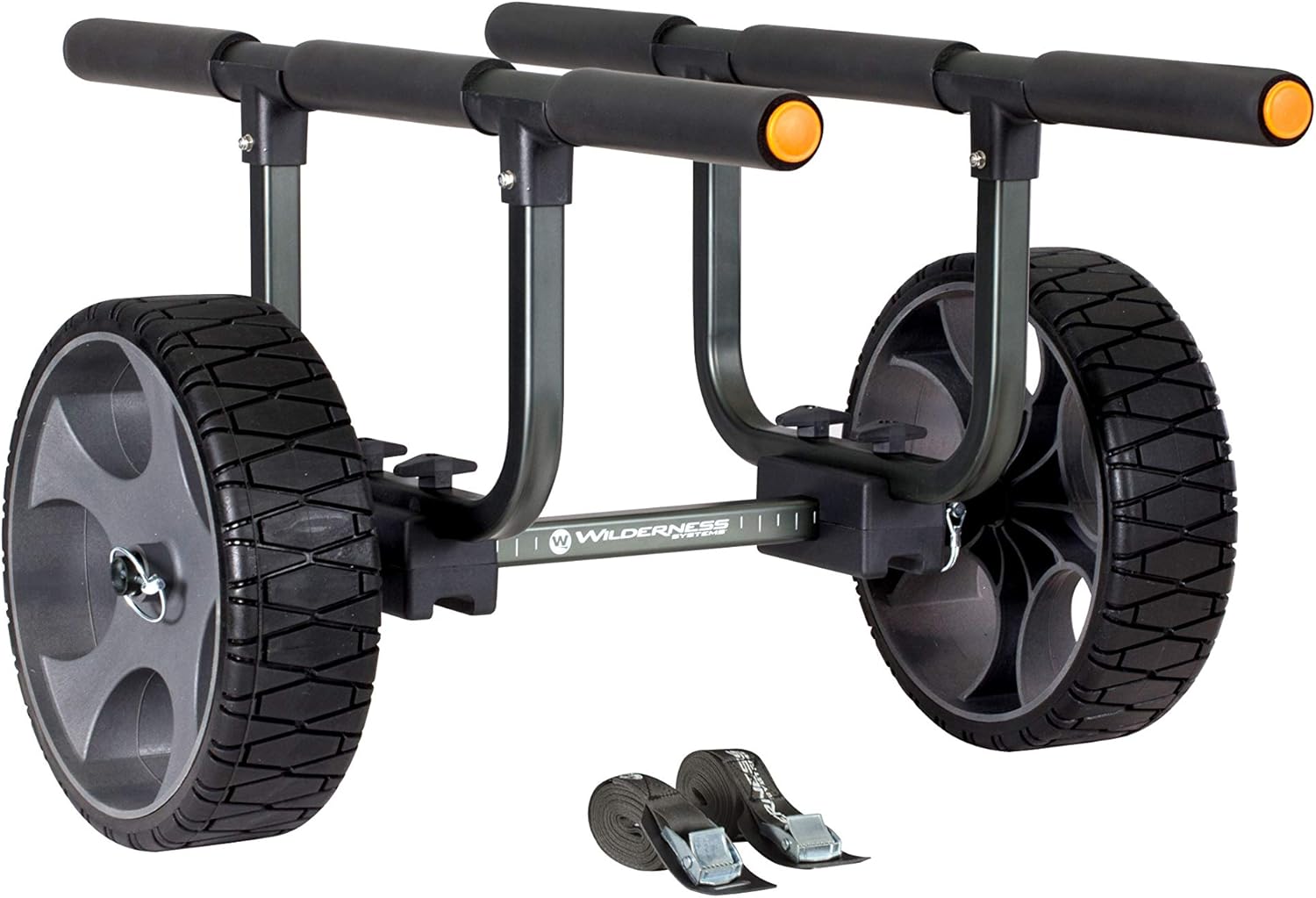
For the solo paddler, Wilderness Systems offers the Heavy Duty.Look at this, no one ever says this. Once you reach the lake, your cart will wait for you while you paddle.First of all, it can be stowed in most kayak dry wells because of how compact it collapses. Take the trolley for a spin.Secondly, it can’t twist on a slope since it has a 450-pound capacity and an adjustable bunker-bar frame that grips the hull broad.
Third, you won’t require a kickstand or scupper posts. Buckle up, lower it beneath the hull, and launch.
When an irregular hull would scrape against the wheels, the fourth position is high, and when it would tip, the fourth position is low.Drawbacks: Even with the all-terrain picks, deep sand is still a challenge due to the smaller flat-free wheels. In the palm of your hand, it becomes a cumbersome beast.Optimal for: extended car-to-canoe paddles, big boats, and lone practitioners. Avoid if you are a beach expert or on a tight budget.
Things to Consider Before Buying a Kayak Cart:
Buying a kayak cart involves assessing various factors to ensure optimal performance and convenience. Lightweight designs, wheel durability, and weight capacity all play significant roles in your kayaking experience. Understanding these elements helps you make an informed purchase that suits your specific needs.
Weight Capacity and Vessel Dimensions
Selecting a cart with an appropriate weight capacity ensures safe transport of your kayak. Different models support varying weights, so verify the specifications to avoid potential damage during transit.
Terrain Compatibility and Ground Clearance
Analyzing the terrain you will navigate is imperative. Carts designed for uneven ground often have larger wheels and higher ground clearance, providing stability on challenging surfaces.
Specific terrain types, such as sandy beaches or rocky trails, dictate the kind of cart best suited for your needs. Carts with larger, wider wheels perform better on sand, while those with higher ground clearance enable smooth transport over rocks or roots. A careful evaluation ensures that your cart can handle the environments you frequent, reducing the likelihood of unexpected issues during transport. Such foresight enhances your overall kayaking experience.
Scupper Carts vs. Platform Designs
Scupper carts fit directly into the kayak’s scupper holes, providing stability during transport. Alternatively, platform designs offer a flat surface that can support various shapes and sizes, making them versatile but potentially less secure.
Plug-In vs. Universal Strap-Over Models
Plug-in models attach directly to kayak fittings, allowing for a quick and easy setup. Universal strap-over models, conversely, utilize adjustable straps that can accommodate any kayak shape, ensuring a snug fit.
Plug-in models are ideal for those with specific kayak fittings, streamlining the loading process. In contrast, universal strap-over models provide unmatched flexibility, easily adapting to different kayaks, making them a favorable choice for multi-kayak households. Each option has its own set of advantages and functions effectively under various conditions.
Identifying the Optimal Balance Point
Locating the balance point is crucial for easy transport. This point typically lies around one-third of the way from the bow. Finding this spot allows for more comfortable lifting and stability, resulting in a smoother journey on the cart.
Mastering Tie-Down and Cam Strap Techniques
Utilizing tie-downs effectively prevents shifting during transit. Always loop the cam straps around the kayak and cart several times for maximum grip. Tighten the straps by pulling on the free end until snug, ensuring everything stays secure.
Practicing the tie-down technique with your kayak on the cart fosters confidence in your setup. Begin by wrapping straps through appropriate mounting points, not just around the hull. After securing, a gentle tug on both sides assures snugness without excessive tightness, protecting the kayak’s structure and paint. This careful approach minimizes stress on the kayak while allowing for safe transport across various terrains.
Preventing Corrosion in Saltwater Environments
Avoiding corrosion entails rinsing your kayak cart thoroughly after each use in saltwater. Salt deposits can quickly compromise metal components, leading to rust and deterioration. Keeping the cart clean will minimize these risks significantly.
Proper Cleaning and Storage Procedures
Cleaning your kayak cart involves more than a simple rinse. Use a mild detergent and a soft brush to scrub wheel surfaces, axles, and frame components. After cleaning, dry everything completely to prevent moisture accumulation.
Storing your kayak cart correctly enhances longevity. Opt for a cool, shaded area and elevate it off the ground to avoid moisture exposure. Wrapping straps and covering the cart can protect it from dust and potential damage. Ensuring that wheels are stored off the ground prevents flat spots from forming, preserving their integrity for future outings.
Final Words
Consider weight capacity, wheel type, and dimensions when selecting a kayak cart. Each feature influences ease of transport and convenience. Evaluating your specific needs, such as storage and portability, ensures you choose the right cart. A well-chosen kayak cart enhances your experience on the water and makes logistics more manageable.
Leave a Reply