
Don’t let searching for the best pack rafts become a chore when you just want to explore the wild backcountry. Are you tired of heavy gear holding you back from epic river crossings? We’ve tested the top ultralight options to help you find a durable boat that won’t fail you. Discover how these incredible tools can transform your next wilderness adventure into a legendary journey. Here are the most reliable models on the market.
Contents
- Top 7 Pack Rafts:
- 7: Catalyst Outdoors Ultra-Lightweight Packraft
- 6: HIKULA Lightweight TPU Packraft
- 5: WONITAGO TPU Soft Seat Packraft 6.8ft
- 4: AQUAGLIDE Backwoods Expedition 85
- 3: Advanced Elements Packlite+ Packraft
- 2: Sea Eagle PF7 PackFish7
- 1: Kokopelli Platte
- Things to Consider Before Buying a Pack Raft:
- Ultralight models for backcountry trekking
- Self-bailing versus spray deck configurations
- High-performance whitewater designs
- Material durability and denier ratings
- Total weight and packed dimensions
- Weight capacity and passenger volume
- Advantages of multi-modal travel and portability
- Limitations in hull speed and wind resistance
- Assessing your primary water environment
- Determining necessary cargo storage options
- Sizing for leg room and torso fit
- Selecting Four-Piece Breakdown Paddles
- Compact Personal Flotation Devices (PFDs)
- Dry Bags and Internal Storage Systems
- Summing up
Top 7 Pack Rafts:
7: Catalyst Outdoors Ultra-Lightweight Packraft

If you’re a hiker who values every cubic inch, you should get the Catalyst Outdoors packraft.Even without provisions or shelter, the majority of boats will use half of your load. Its corner is where this one vanishes.To start, it collapses to a size that fits perfectly into a backpack—much smaller than the average kayak.The next one is a featherweight 6 pounds, equipped to withstand rough coastlines thanks to its 70-denier TPU tube and 210-denier floor.
Lastly, it doesn’t require a separate pump because it comes with an inflation bag.Negative: With all the gear, the 265-pound restriction becomes very tight. Be cautious when landing on the thin floor. Very calm, level sea.Those who prefer to travel light and hike with a small pack will find this to be the ideal model. The current is too strong for larger paddlers or anyone else.
6: HIKULA Lightweight TPU Packraft

When lightness is paramount, go no farther than the HIKULA TPU packraft.By mile ten, you’ll feel every additional pound in your back. The boat is nearly destroyed by the HIKULA.The first is its weight: 5.7 pounds. This makes it one of the lightest actual packrafts available, and it scarcely registers when climbing.The next thing is that it is sturdy despite its lightweight design thanks to a 420D floor and a dual-layer 210D TPU body.
Last but not least: an arrow-shaped hull featuring an inflatable seat ensures smooth tracking and protects you from the chilly floor.Drawbacks: Best suited for smaller paddlers, the tiny size. Absolutely no points of gear lash. Made solely for use in flat, placid waters.For hikers who count grams and for journeys where weight is an issue, opt for the lighter option. Large loads or water in motion are not suitable.
5: WONITAGO TPU Soft Seat Packraft 6.8ft
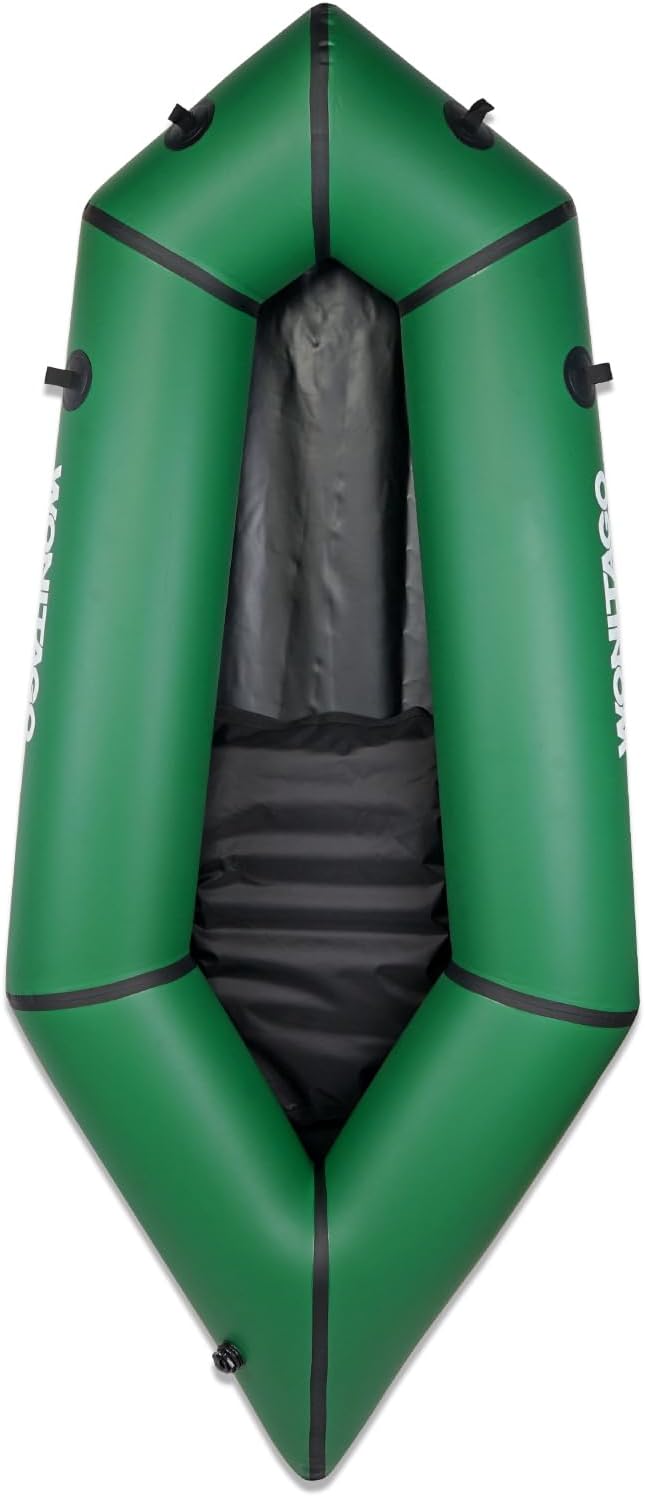
Introducing the WONITAGO TPU packraft—the ultimate lightweight option that won’t sacrifice comfort.Even on the lightest rafts, you can expect a painful back and a hard seat. That is addressed by this one without making it heavier.First, for those lengthy journeys, an inflatable, plush seat will keep you off the ground and provide much-needed back support.Next up: a 420D floor and 6 lbs of 210D TPU— ultralight and tough enough to handle rocky put-ins.
Last but not least: compared to oblong budget rafts, an arrow-shaped hull paddles faster and tracks straighter.Negative: at 6.8 feet, it is on the tiny side and may be cramped for paddlers of a better stature. centered on flat water. No place to attach stuff to the deck.Who it’s ideal for: long-distance paddlers who go hiking. Do not use on whitewater or when transporting heavy items.
4: AQUAGLIDE Backwoods Expedition 85

The ideal packraft to carry a full load overnight is the Aquaglide Backwoods Expedition 85.Because most packrafts don’t have any space for stuff, you end up with your pack riding on your lap and losing your equilibrium.To start, you’ll need some MOLLE plates, mesh bags, and a deck cargo bungee to secure your tent, dry bag, and food supplies.Next, it looks and rides like a tourer at 8 feet 6 inches, but it weighs only 12 pounds when packed.
At long last, a quick-release fin may be quickly removed for use in narrow creeks and reattached for use in deeper streams.Downside: bulkier compared to the ultralight TPU rafts. Under load, the 300-pound limit is quickly filled. In shallow water, the fin may come loose.Paddlers who lug around a lot of gear and those on multi-day trips will love this. This is not for you if you are someone who counts grams or floated around all day.
3: Advanced Elements Packlite+ Packraft

When you paddle with others, the Advanced Elements Packlite+ is your best bet for a packraft.If you and your companion both want to go on the raft, but you only bought one, you’ll need to get another one. With just one hull, the Packlite+ takes care of that.One can paddle it alone or join forces with another person for a joint voyage; the boat can accommodate either number of riders.Secondly, it is one of the steadiest rafts here because to its wide 39-inch beam, which gives both novice and experienced paddlers peace of mind.
At last, when set to UltraLite mode, it weighs only 7 pounds and has its own built-in backpack for transport.However, there is an additional setup phase due to the removable floor. Compared to a narrow hull, the wide beam paddles at a slower speed. Not as affordable as the TPU rafts.Perfect for: vacationing buddies and couples. Solo paddlers focused on speed should not use this.
2: Sea Eagle PF7 PackFish7

When fishing in distant areas, the Sea Eagle PackFish7 is your best bet.Using a shaky raft to cast increases the likelihood of a soaked seat, lost rod storage, and equipment falling into the water. A PackFish7 takes care of all that.To start, you and your gear will stay dry for the entire day thanks to the fully sealed hull.Next, the rail has two built-in rod holders and two fish rulers that are 36 inches each, so you may cast without using your hands and measure your catch on the go.
Last but not least: it comes with everything you need to start fishing right away, including the hull, backpack, seat, foot pump, and oar set.Downside: not as lightweight or compact as a packraft without additions. Emphasized for steadiness rather than quickness. Floats more than the average person requires.Backcountry anglers and paddlers that prioritize stability will find this the best board. Pooperts or those who count grams will not like this.
1: Kokopelli Platte

The Kokopelli Platte, which is unique among packrafts in that it mimics the action of a hardshell kayak when paddling, is our top pick for 2026.If you paddle too hard, every other raft here will bend and drift; the only one that can stay put is the one with the soft floor. The Platte takes it off.The first step is to use a high-pressure drop-stitch floor to snap the hull tight. This allows the ship to glide instead of wallowing and track straight.Additionally, the 1000-denier reinforced PVC sidewalls are designed to withstand gravel bars, dragging landings, and years of rough use.
Thirdly, genuine kayak ergonomics include an EVA foam seat and a foot block that secure you for an efficient and forceful stroke.Forth, it comes as a whole set with the paddle, pump, and carrying case already attached, is compact when not in use, and is ready to go the moment you are.Downside: this pack-down is the heaviest and bulkiest one here. The time required to inflate the hard floor is more. This boat is the priciest one here.The ideal choice for performance paddlers who value packability above all else. Intended users: those on a strict budget or who want lighter designs.
Things to Consider Before Buying a Pack Raft:
Over time, pack rafts have gained popularity among outdoor enthusiasts seeking versatile and lightweight options for water adventures. Evaluating your unique needs, the terrain you’ll navigate, and the types of activities you plan to pursue will ensure a thoughtful purchasing decision.
Ultralight models for backcountry trekking
Ultralight pack rafts excel in weight and portability, making them ideal for backcountry trekking. Designed with minimalist features, these models offer easy transport without compromising important performance.
Self-bailing versus spray deck configurations
Choosing between self-bailing and spray deck configurations depends on your paddling environment. Self-bailing rafts allow water to drain automatically, while spray decks provide additional protection from splashes.
Self-bailing systems are generally better suited for areas with fast-moving water, as they help maintain buoyancy by keeping the raft lighter. Meanwhile, spray decks are beneficial in calm waters, where splashes can be an issue. Specific models may even offer combinations, catering to diverse conditions, thus enhancing versatility on different adventures.
High-performance whitewater designs
High-performance whitewater pack rafts feature advanced materials and design for navigating turbulent waters. These models often include reinforced seams and precise control for better maneuverability in challenging conditions.
Engineered for durability and stability, high-performance designs are favored by experienced paddlers tackling rivers with swift currents and obstacles. With their innovative construction, they can withstand impacts while delivering excellent responsiveness. Well-known brands frequently incorporate specialized features like adjustable seating and thigh straps, allowing for greater control and adaptability in extreme conditions.
Material durability and denier ratings
Focusing on material durability ensures the raft withstands various conditions. Denier ratings indicate the strength of the fabric; higher ratings signify better abrasion resistance and longevity.
Total weight and packed dimensions
Evaluating total weight and packed dimensions aids in transport and storage decisions. A lighter raft is easier to carry, while compact dimensions can fit into tighter spaces during your adventures.
Determining the ideal weight capacity involves assessing the raft’s transportability versus stability on the water. A pack raft may weigh as little as 5 to 10 pounds, making it manageable. However, ensure that the packed dimensions are suitable for your gear, as some models compress to fit into small backpacks, enhancing portability.
Weight capacity and passenger volume
Assessing weight capacity and passenger volume is crucial for safety and performance. Overloading your raft risks instability, impacting both fun and safety on the water.
Understanding the specifications for weight capacity often means the difference between an enjoyable experience and potential risks. Pack rafts typically cater to one or two passengers, with varying capacities ranging from around 300 to 600 pounds. Knowing the total weight, including gear, will inform a suitable choice, ensuring you remain safely afloat.
Advantages of multi-modal travel and portability
Packrafts excel in multi-modal travel, allowing for seamless transitions between hiking, biking, and paddling. Their lightweight design means you can carry them in a backpack without feeling burdened, making remote and inaccessible waterways more approachable. The ability to easily stow a packraft expands your adventure options significantly.
Limitations in hull speed and wind resistance
Hull speed is a notable limitation of packrafts; they often lag behind traditional boats in terms of velocity on the water. Wind resistance can exacerbate this drawback, making navigation challenging in breezy conditions. While they perform well on calm waters, packrafts may struggle in choppy or windy environments, requiring careful planning when choosing routes.
Packrafts typically have a flatter hull design, which contributes to their portability but impacts speed. On rivers with a strong current, you’ll notice that packrafts take longer to gain momentum compared to rigid kayaks. Additionally, wind can push against the surface area of the packraft, making it difficult to maintain a straight course. The combination of these factors necessitates adjustments to your paddling technique and route planning, especially in less-than-ideal weather conditions.
Assessing your primary water environment
Identify the types of water bodies most frequented, whether they are still lakes or whitewater streams. Conditions like currents, waves, and obstacles directly affect your raft choice. Different rafts excel in various environments, making this an important first step.
Determining necessary cargo storage options
Assess your equipment needs to decide on storage capacity. If you plan extended trips, prioritize rafts with ample cargo space, securing additional items like safety gear, food, and camping supplies. Evaluate how storage configurations impact the raft’s overall balance and performance.
Options vary widely, from small compartments to external lashing points. Knowing how much gear will accompany you helps in selecting a pack raft that can accommodate everything without compromising stability. Some models may even offer customizable storage solutions, allowing for versatility based on different trip types.
Sizing for leg room and torso fit
Choosing the right size involves more than just height; consider leg length and torso dimensions. A snug fit enhances control, while sufficient legroom allows for comfort during longer outings. Testing the fit before purchase can reveal potential issues.
Correct sizing is key to achieving optimal performance, especially in rapid water. If a raft is too tight, movement may be restricted, impacting paddling efficiency and overall maneuverability. Conversely, an overly spacious boat can introduce instability, affecting your balance and comfort on the water.
Selecting Four-Piece Breakdown Paddles
Four-piece breakdown paddles provide convenience and portability, making them ideal for packrafters. Compact when disassembled, these paddles are easy to store and transport, fitting snugly into your rafts or packs. Look for lightweight materials that offer durability and strength on the water.
Compact Personal Flotation Devices (PFDs)
Compact PFDs are important for any packrafter prioritizing safety without compromising mobility. They should offer a snug fit while allowing freedom of movement. Models designed specifically for packrafters often integrate small pockets and straps for important gear, enhancing usability.
Considering comfort and fit is crucial when selecting a PFD. Look for options with adjustable straps and lightweight materials that won’t hinder your movement during paddling. Models that include features like quick-release buckles can provide peace of mind in emergencies, allowing for swift removal if needed.
Dry Bags and Internal Storage Systems
Dry bags and internal storage systems protect your gear from water damage. Choose bags that are highly waterproof, durable, and easy to pack. Opting for brightly colored bags can improve visibility in the water and make them easy to locate on shore.
Effective storage solutions can define your packrafting experience. A well-organized internal storage system allows easy access to importants while maintaining a streamlined setup. Look for modular designs that enable you to customize the layout according to your specific gear and preferences, ensuring that everything is secure and ready for use.
Summing up
Assessing your needs is key before purchasing a pack raft. Consider your intended activities, preferred waterways, and storage options. Familiarity with the various designs, materials, and features available can significantly enhance your choice. Ultimately, ensuring your selected raft aligns with your specific goals will lead to a more satisfying and enjoyable experience.
Leave a Reply