
Best snowshoes help you conquer deep powder and reclaim your winter trails. If you hate sinking, our outdoor gear experts tested top models for traction, fit, and durability to save you time and money. You’ll find easy recommendations that match your style-backcountry or casual walks-so you get confident, comfortable miles right away. Feel the thrilling freedom of worry-free winter adventures as we dive into the picks and how to choose.
Contents
- Top 7 Snowshoes:
- 7: Retrospec Drifter Snowshoes
- 6: Yukon Charlie’s Advanced Snowshoe Kit
- 5: G2 Lightweight Snowshoes with Trekking Poles
- 4: Odoland 4-in-1 Snowshoes with Poles and Gaiters
- 3: MSR Evo Trail 22-Inch Snowshoes
- 2: Crescent Moon Eco Eva Foam Snowshoes
- 1: Tubbs Wayfinder Snowshoe
- Things to Consider Before Buying a Snowshoe:
- Flat Terrain and Recreational Models
- Rolling Terrain and Backcountry Models
- Technical Mountain and Racing Models
- Understanding Frame Geometry and Surface Area
- Evaluating Binding Systems for Stability
- Aluminum vs. Composite Decking
- Stainless Steel vs. Carbon Steel Crampons
- Fixed vs. Rotating Pivot Points
- Securing the Footwear Harness
- Testing Range of Motion and Comfort
- Waterproof Footwear and Gaiter Selection
- Emergency Repair Kits for the Field
- Summing up
Top 7 Snowshoes:
7: Retrospec Drifter Snowshoes

For a first-time skier or snowboarder on a budget, nothing beats the Retrospec Drifter.As of right now, you have no idea if snowshoeing is something you enjoy. It feels retrograde to commit heavily before you’ve given it a go.The first component is a lightweight, durable, and easy-to-forget aluminum alloy frame and polyethylene deck—the kind of material used by serious pairings.Pull, click, locked in—with gloves still on—with double-ratchet bindings next.
As a last feature, the built-in heel lifters allow you to lower your calves to a level angle while climbing. That is the key to climbing the hill.Downside: the box does not contain any poles. A mesh bag is more suited for storage than hauling. Plastic is used for ratchet straps.Snowshoers and hikers who only go out in the winter should try this. Deep powder or all-day mileage are not your cup of tea.
6: Yukon Charlie’s Advanced Snowshoe Kit

For those who want convenience, we recommend the Yukon Charlie’s Advanced Kit.When you’re in a parking lot with just snowshoes, you’ll quickly realize that you need poles as well.You only need to pull in and out once with the Fast Fit II Easy-Pull binding; there’s no need to thread at all.Walking poles with snow baskets come next; the broad basket prevents the tip from plunging into the powder.And lastly, a 4.2-pound, 8-by-25-inch frame that can support persons weighing 151 to 200 pounds.
The weight rating has a little window of opportunity; beyond that, buoyancy is impaired. Just one size of frame available. Fundamental are poles.Those looking for a turnkey solution on day one would love this. Heavy hikers or those using trekking poles should not do this.
5: G2 Lightweight Snowshoes with Trekking Poles

When it comes to choosing the correct size snowshoes, the G2 set is your best bet.The vast majority of novices will buy a pair and end up losing money regardless.We start with four different frame lengths: 21, 25, 30, and 36 inches. Your choice is based on your laden body mass.The next thing is a low-temperature ratchet binding that only requires one finger to close.And last but not least, a heel lift and EVA-cushioned footbed with flex pivot bar—the pivot lowers the tail to make walking, not shuffling, possible.
Negative: The 36-inch frame makes it difficult to navigate tight paths. Get your loaded weight before placing an order. Fundamental are poles.Ideal for: shoppers in the middle of a size range and athletes on the go. Avoid if you have narrow switchbacks or are looking for a universal set.
4: Odoland 4-in-1 Snowshoes with Poles and Gaiters
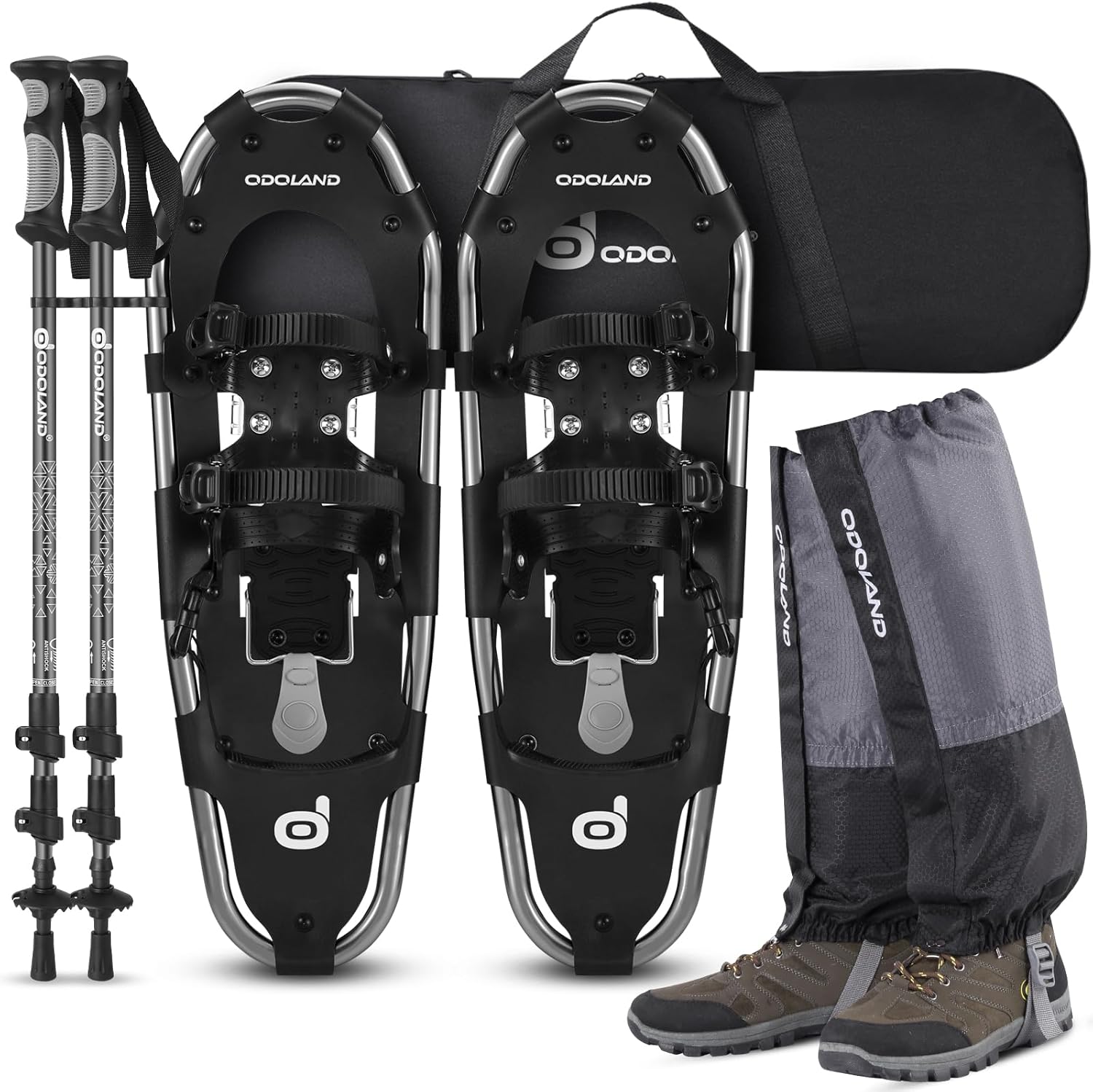
When it’s really snowing, the Odoland 4-in-1 is your best bet.The space between the shin and the boot is filled with new powder. Within the first hour, your socks become soggy.First, you’ll have all the gear you need for snow, including waterproof gaiters that will keep powder out. They are not found anywhere else.The next size up, the 30-inch, can hold 160 to 250 pounds, which is plenty of room for both a pack and freshly fallen snow.
The last piece of equipment needed is a pair of sturdy sawtooth crampons for each shoe, together with a heel lift that bites under both the ball and the heel.Negative: the gaiters are too snug for large boots. Not a haul bag, but a small nylon tote. Fundamental are poles.Ideal for snow days with powder, damp snow, and carrying packs. Owners of gaiters and groomed pathways should not use this.
3: MSR Evo Trail 22-Inch Snowshoes

Built to last, the MSR Evo Trail is the greatest packed-trail workhorse.Cheap snowshoes only last a couple of seasons. Frayed frames, broken decks, and more purchases.The first is a set of steel crampons and traction rails that run the length of the deck; these will provide a firm grasp on ice, not only powder.On to the next step: an injection-molded UniBody deck. This one-piece design eliminates the need for a bending frame.
A 22-inch shoe may be transformed into a powder shoe by simply bolting on six-inch flotation tails. Lastly, there are attachment points for these tails.Drawback: you can’t buy those tails with them. In new powder, twenty-two inches is a tiny platform in their absence. The absence of poles.Perfect for: winter hikers who desire a single pair that will last a long time. Do not purchase if you are planning a single trip or if you have a history of deep snow.
2: Crescent Moon Eco Eva Foam Snowshoes

For those who value speed, the Crescent Moon Eco Eva is an excellent choice.Thus far, every pair has consisted of a frame and a deck spread across it. A flat-footed gait is enforced, but you float on it.The first is the one-piece EVA foam construction; there is no metal frame to flex or corrode.Secondly, the pair weighs 2 pounds, 8 ounces, which is approximately half of the weight of the metal shoes.At last, jogging on snow is possible with these rocker-platform, teardrop-shaped shoes that feature sculpted ice spikes. They roll like a running shoe.
Downside: snow builds up around hook-and-loop fasteners. Long ascents engage the calves instead of the heels, you’ll be pleasantly surprised. Limited to a single size.Who it’s best for: trail runners, quick hikers, frequenters of compacted snow. Deep powder, hefty loads, and steep slopes are not your cup of tea.
1: Tubbs Wayfinder Snowshoe

This duo is the epitome of sophisticated leisure.You have to re-seat the straps in the cold in every other shoe here. Dexterity disappears.When hiking, the straps relax.At the top of the list is the BOA Fit System, which allows you to equally shut the binding around your boot—heel strap and all—with the turn of a dial.Second, there’s the Fit-Step frame, which absorbs 10% less force at the knee, ankle, and hip joints than a standard walking frame.Thirdly, there’s SoftTec decking that has a rotating toe cord, so instead of throwing snow up your back, the tail drops to shed it.
A fourth item is a pair of crampons made of carbon steel, which can be used for climbing, descending, and gliding across slopes. These crampons include toe and heel crampons as well as front and rear brake teeth.The only size available is for guys. When the strap breaks, you can find a workaround, but when the dial breaks, you’re stuck. Alpine ice isn’t designed for crampons.Ideal for: casual hikers, casual shoppers, and occasional snowshoers. Not recommended for: Extreme mountaineers or those on a tight budget.
Things to Consider Before Buying a Snowshoe:
Snowshoes can be classified into several categories based on the type of activity they support. These include models designed for recreational use, rugged backcountry trails, or technical mountain climbing. Understanding these distinctions can enhance your snowshoeing experience.
Flat Terrain and Recreational Models
Flat terrain snowshoes are typically wider and offer more surface area, enabling easier movement over snow. These models are great for casual hikes and trails, providing comfort and stability.
Rolling Terrain and Backcountry Models
Rolling terrain and backcountry models feature a shape that accommodates diverse elevations. These snowshoes often have a slightly tapered form, making them suitable for uneven landscapes.
Rolling terrain snowshoes usually incorporate durable materials designed to withstand the rigors of backcountry excursions. Such models can include features like additional traction devices, ensuring safety on icy slopes and an improved grip when traversing variable terrain.
Technical Mountain and Racing Models
Technical mountain and racing models prioritize performance and agility. With a streamlined design, these snowshoes allow for swift, powerful movements on steep climbs.
Models geared toward technical mountain use often incorporate advanced features such as lightweight, robust frames and specialized binding systems. These enhancements promote greater responsiveness and efficiency, crucial for backcountry athletes aiming to conquer challenging ascents and descents swiftly.
Understanding Frame Geometry and Surface Area
Frame design significantly impacts performance on soft snow. Shapes with wider frames distribute weight more efficiently, enhancing flotation. With a larger surface area, the ability to stay atop powder increases, reducing the chance of sinking.
An elongated frame may suit those tackling deeper snow, while a shorter, wider model can provide agility in varied terrain. Geometrical features, such as how curves adapt to different snow types, should also influence your choice. Adjusting your selection based on terrain-whether flat trails or steep hills-can create a more enjoyable experience overall.
Evaluating Binding Systems for Stability
Binding systems ensure a secure fit, affecting your stability and control on the snow. Selecting a model with effective adjustments allows for easier use with various footwear types.
A tight, comfortable binding can improve responsiveness while navigating tricky terrain. Consider the ease of entry and exit when evaluating systems, especially in changing weather conditions. Some bindings may also feature additional security straps, enhancing overall stability during movement. Having a dependable binding enhances your ability to maneuver effectively across different snow textures.
Aluminum vs. Composite Decking
Aluminum decking is favored for its strength and longevity, making it ideal for rugged terrain. Composite materials, while lighter and more forgiving, can sacrifice some performance in extreme conditions. Consider the intended use when deciding between these options to find a balance between durability and comfort.
Stainless Steel vs. Carbon Steel Crampons
Stainless steel crampons resist corrosion and maintain sharpness over time, providing reliable traction. Carbon steel, lighter and often less expensive, requires careful maintenance to prevent rust. Both materials have unique advantages that affect performance based on snow conditions and individual user preferences.
Choosing between stainless steel and carbon steel crampons often hinges on your snowshoeing style. For frequent exposure to wet environments, stainless steel is the superior choice due to its corrosion resistance. Conversely, carbon steel may be suitable for dry conditions and lower-cost options. Balance the need for durability with the maintenance commitment required for each type.
Fixed vs. Rotating Pivot Points
Fixed pivot points provide stability, making them favorable for beginners or those on flat terrain. Rotating pivot points, however, promote natural stride and may enhance maneuverability on varied landscapes. Assess your snowshoeing environment to determine which pivot style aligns better with your personal comfort and performance preferences.
When considering fixed versus rotating pivot points, the choice often reflects your ability to adapt to changing snow conditions. Fixed points excel in predictable environments, as they minimize foot strain. In contrast, rotating versions allow for a more natural gait, particularly beneficial in deep or uneven snow. Opt for the design that best suits your snowshoeing habits and terrain expectations.
Securing the Footwear Harness
Properly securing the footwear harness ensures stability during use. Adjust the straps until they fit snugly around your boot without constricting circulation. This allows for optimal performance and comfort as you traverse various terrain types.
Often, a snug fit can make a significant difference in maintaining control on uneven ground. Most modern snowshoes feature adjustable harnesses designed for different boot sizes. Take the time to experiment with adjustments until you find the perfect balance between tightness and ease of entry.
Testing Range of Motion and Comfort
Testing your range of motion is necessary for an enjoyable snowshoeing experience. Walk around in your snowshoes to assess how well your foot moves inside the harness. A comfortable fit will allow for natural movement without excessive constriction.
Before venturing out on an extended trek, conduct a few practice strides in a controlled area. This helps identify any points of irritation or discomfort. Ensuring that you can move freely not only enhances enjoyment but also boosts your efficiency on the trail.
Waterproof Footwear and Gaiter Selection
Waterproof footwear is important to keep your feet dry and warm. Pair well-fitted boots with gaiters to prevent snow from entering, enhancing comfort during your adventures.
Selecting the right waterproof footwear involves considering materials and insulation. Look for boots made of breathable, waterproof fabrics like Gore-Tex. Insulation levels vary, so choose based on the temperature range you’ll encounter. Gaiters should fit securely around your ankles, keeping snow out while allowing enough room for movement. Ensure they are made from durable, water-resistant material for added protection.
Emergency Repair Kits for the Field
An emergency repair kit is indispensable for any snowshoer. Include importants like duct tape, spare bindings, and multi-tools to address unexpected gear failures on the trail.
Your emergency repair kit should be lightweight yet comprehensive. Including items like spare straps, extra toe clips, and adhesive patches can help you quickly fix minor issues, preventing more significant problems from disrupting your trip. Always check your kit before venturing out to ensure all components are intact and functional.
Summing up
Evaluating snowshoes requires considering your primary activities, weight capacity, and terrain compatibility. Assess personal comfort and fit, alongside the materials used for durability and performance. Being informed about necessary accessories can also enhance your experience on snow-covered trails, ultimately ensuring that you enjoy your adventure fully.
Leave a Reply