
Finding the best survival knives shouldn’t be a guessing game when your safety is on the line. You need a tool that won’t fail during a heart-pounding emergency. Whether you’re practicing bushcraft or stuck in the wild, a rugged fixed blade is your ultimate lifeline. We’ve tested the most dependable gear to ensure you stay prepared for anything. Here are the top-rated options that provide the strength and durability you deserve.
Contents
- Top 7 SURVIVAL KNIVES:
- 7. Morakniv Companion Heavy Duty
- 6. Gerber Ultimate Survival Knife
- 5. Gerber StrongArm
- 4. Morakniv Garberg Full Tang
- 3. Gerber LMF II Infantry
- 2. ESEE-6P Fixed Blade
- 1. ESEE Laser Strike
- Things to Consider Before Buying a SURVIVAL KNIVE:
- Fixed Blade vs. Folding Mechanisms
- Full Tang vs. Partial Tang Construction
- High Carbon vs. Stainless Steel Performance
- Blade Geometry and Edge Grinds
- Grip Materials and Texture Security
- Pommel Utility and Guard Protection
- Plain Edge vs. Partially Serrated Blades
- Weight Distribution and Portability Trade-offs
- Sharpening Techniques for Peak Performance
- Corrosion Prevention and Sheath Care
- Summing up
Top 7 SURVIVAL KNIVES:
7. Morakniv Companion Heavy Duty

You can get the best-selling and most highly-rated survival knife, the Morakniv Companion Heavy Duty.You can almost throw away most cheap knives. The 4.1-inch, 3.2 mm thick, Swedish-made Companion HD doesn’t.The first step is a 3.2 mm thick 1095 carbon Scandi grind. Able to baton kindling and sharpen feathersticks with equal ease. You can use any flat stone to reshape it.Afterwards, a very large grip featuring a high-friction surface. Feels great on any size hand. Keeps feet dry in cold and damp conditions.
Lastly, a belt clip and a strong plastic sheath. On and off with a single hand. A drain hole ensures that it is field-ready.Downsides: carbon steel corrodes even when not oiled, extreme batoning is limited by partial tang, and there is no ferro rod included.Preppers on a tight budget, scouts, bushcrafters, and hikers will love it.People who require full-scale building should not use this.
6. Gerber Ultimate Survival Knife
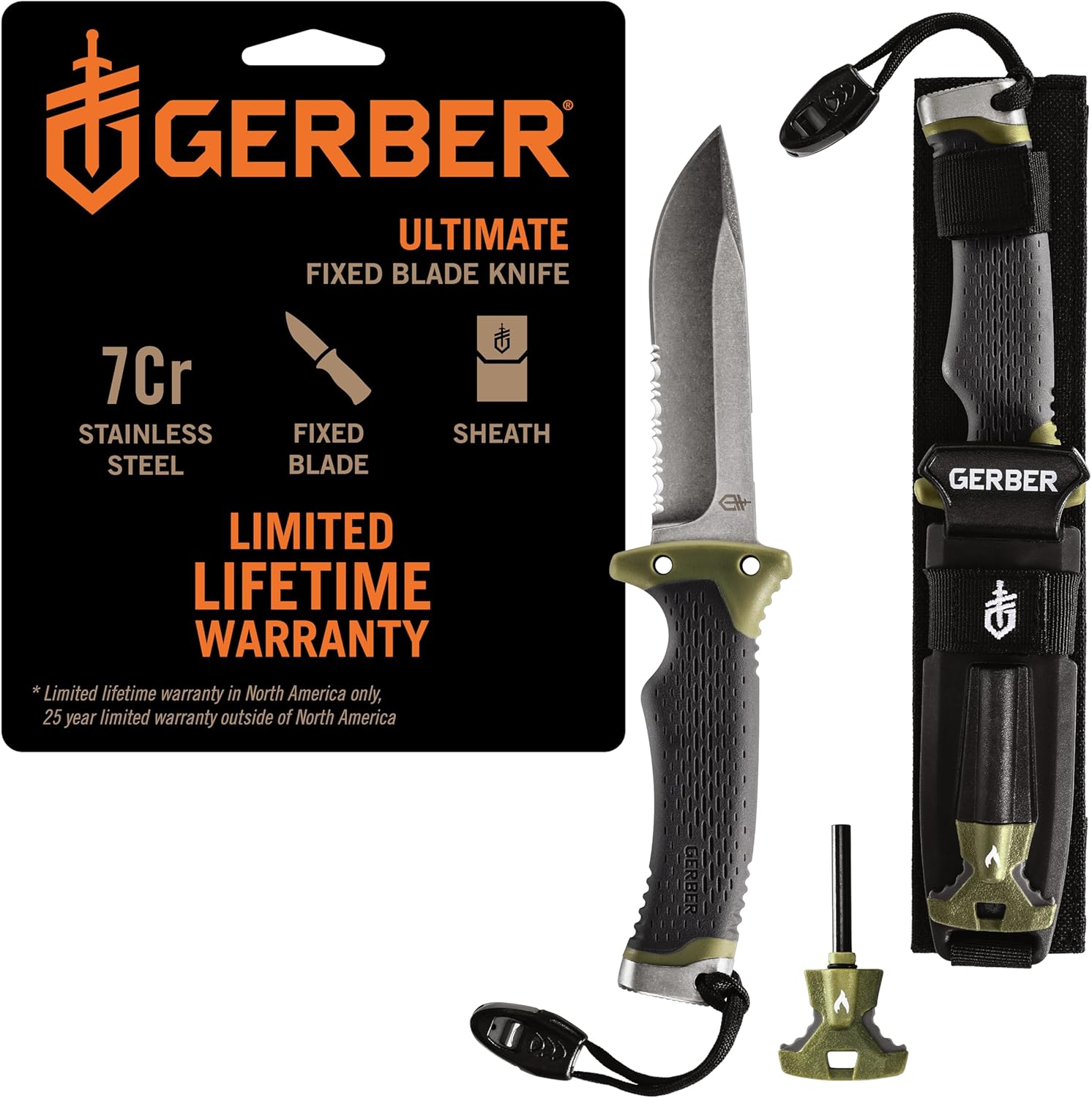
As far as beginner survival knives go, nothing beats the Gerber Ultimate Survival Knife in 2026.The majority of inexpensive knives only come with a blade. The 4.8-inch Gerber package solves that problem; it contains a ferro rod, sharpening, whistle, and hammer pommel all in one.An integral ferro rod is the first component of the sheath. Fire even when it’s drenched if you hit it on the back. Firestarter not included.Coming up next: a built-in diamond finisher. Embraces life within the protective barrier. Stay prepared for any situation with Blade.
Lastly: a steel hammer pommel and an emergency whistle. Two things that the majority of knives fail to do are drive stakes and signal for help.Drawbacks: the nylon sheath is simple, hard batoning is limited by the partial tang, and stainless dulls more quickly than carbon.Recommended for: newcomers, outdoor enthusiasts, and those constructing emergency kits.Who it is not for: extreme bushcrafters who insist on full-tang strength.
5. Gerber StrongArm

One of the greatest all-around survival knives is the Gerber StrongArm, which happens to be Gerber’s best-selling fixed-blade knife.For the price, the majority of knives are either too delicate or too tactical. The two 4.8-inch full-tang 420HC StrongArm nails are manufactured in Portland, Oregon.A full-tang 420HC drop-point knife with a Cerakote coating is up first. Carving, skinning, and batoning are all handled by drop points. Without additional upkeep, cerakote resists rusting.The second one is a diamond-textured rubberized grip. Releases when your hand is damp or covered with gloves. Endless use with no hot spots.
Thirdly, a multi-mount sheath that is compatible with MOLLE systems. Three different ways to carry: vertically, horizontally, and with a MOLLE system. At this pricing, no knife can compare.There is no fire steel spine, the pommel is plain, and the 420HC wears out more quickly than carbon alternatives.Who it’s best for: camping, emergency preparedness, the military, and those looking to get a fixed-blade knife for the first time.Caution: Extreme bushcrafters requiring edge retention from carbon steel should not use this.
4. Morakniv Garberg Full Tang

When it comes to full-tang stainless survival knives, the Morakniv Garberg is unrivaled.Partial tang is the standard for Mora knives. The 4.3-inch Garberg is a Swedish-made full-tang stainless steel Sandvik 12C27 that breaks that.To start, we have the full-tang stainless steel blade from Sandvik, model 12C27. 12C27 is low-maintenance for damp areas, as it retains a sharp edge and is corrosion-resistant.Furthermore, a sheath that is compatible with many MOLLE mounts is available. Comes with numerous pre-attached carry positions—belts, packs, and MOLLE webbing.
Thirdly, a finger guard and a rubber grip. Guaranteed hold in any environment. When cutting something hard, a finger protector can be a lifesaver.Downsides: The 4.3-inch blade length is too short for most people, the rubber grip doesn’t seem high-quality, and it’s too heavy for casual day hikes.Ideal for: those who live in damp environments, those who are military, bushcrafters, and preppers.Inappropriate for: those tasks that call for a longer blade, such as chopping or batoning.
3. Gerber LMF II Infantry

The Gerber LMF II Infantry, our top pick for a tactical survival knife.True emergencies aren’t typically designed for use with survival knives.Developed in collaboration with the United States military, the Gerber LMF II can cut through wire, shatters glass, and sever seatbelts.First, a 420HC stainless blade that is 4.84 inches long and partially serrated. Seatbelts, rope, and webbing are quickly cut using the serrated edge.Efficiently manages tasks requiring precision.Secondly, a pommel for breaking wires and a point for shattering glass. Constructed with two emergency tools. Remove the need for additional equipment.
Our third product is a tactical sheath that is compatible with leg straps. Fastens to a belt, a vest, or the patello. Produces clear lines when pressed.However, it is a heavy knife, the blade is too thick for precise carving, and the 420HC is softer than carbon alternatives.Ideal for: disaster supplies for vehicles, first responders, preppers, and the military.This is not the right choice for ultralight hikers or those who value precise bushcraft cutting.
2. ESEE-6P Fixed Blade

If you could only bring one knife blade into the woods, it would be the ESEE-6P.You need reach if you’re going to use the ESEE-4. The ESEE-6P bridges the gap with its 6.5-inch blade, identical tested engineering.The first is a full-flat-ground, 6.5-inch 1095 high-carbon blade.Extension for more precise chopping. A shorter blade lacks the adaptability offered by a flat grind.Two, a jimped spine for a firm grasp with the thumb. Gains true command of the sword through feathersticking, tinder preparation, and meticulous labor.
And lastly, a kydex sheath with a detachable clip plate that is compatible with MOLLE systems. It is ambidextrous, has multiple carry positions, and is stiff enough to draw with one hand.Downsides: you’ll need to oil it often, it’s heavier than the ESEE-4 at 10.5 ounces, and it’s a significant investment.Survival teachers, hunters, and those on long outdoor expeditions will benefit the most.Not recommended for: anyone who like low-maintenance steel, ultralight packers, or day hikers.
1. ESEE Laser Strike

The ESEE Laser Strike, which has been tested in the field and has the highest rating of any Amazon survival knife. All around the globe, survival instructors and members of the armed forces carry the Laser Strike. To start, a 4.75-inch blade made of 1095 carbon with a full flat grind. For cutting and slicing, a flat grind is ideal. Fast-sharpening and resilient, 1095 keeps its edge even when beaten.Additionally, there are detachable Micarta scales that conceal a ferro rod and tinder tabs. The fire starter kit is in the handle; all you need is a coin to open the scales. Not a single tool.
Thirdly, a MOLLE clip plate, an adjustable tensioner, and an ambidextrous Kydex sheath. A top-tier sheath, regardless of price. Modular, MOLLE-compatible retaining system.Downsides: 9.5 ounces is too hefty for day hikes, the blade coating prevents spine sparking, and 1095 requires oiling to avoid rust.Survivalists, soldiers, hunters, and those who like to camp in remote areas would love it.Ultralight hikers or those who require stainless steel should not use these.
Things to Consider Before Buying a SURVIVAL KNIVE:
Knife selection impacts your preparedness in survival situations. Assess blade type, materials, handle comfort, and size for optimal functionality. Understanding these factors ensures you choose a knife that meets your survival needs and enhances your outdoor experience.
Fixed Blade vs. Folding Mechanisms
Fixed blade knives offer greater strength and durability, making them suitable for intense tasks. Folding knives are more portable and easier to conceal, ideal for everyday carry.
Full Tang vs. Partial Tang Construction
Full tang construction ensures that the blade extends throughout the handle, providing stability. Partial tang knives may compromise strength but can be lighter and more compact.
Full tang knives are generally preferred for survival situations due to their durability. They prevent breakage under pressure, allowing for more intense use without compromising performance. Partial tang knives, while lighter, may not withstand the same level of stress, making them less reliable for critical tasks.
High Carbon vs. Stainless Steel Performance
High carbon steel offers excellent edge retention and ease of sharpening, while stainless steel provides corrosion resistance and lower maintenance. Assess how each material aligns with your specific survival needs.
Blade Geometry and Edge Grinds
Blade geometry and edge grinds are key factors that affect cutting performance and versatility. Each style has unique features suited for different tasks.
Understanding blade geometry is imperative for selecting the right survival knife. Drop point blades excel in versatility, while tanto tips offer piercing strength. Edge grinds-such as flat or hollow-affect how the knife performs in cutting and slicing tasks. A knife with a well-defined edge can make all the difference in survival scenarios.
Grip Materials and Texture Security
Grip materials significantly affect your knife’s performance. Textured surfaces made from rubber, G10, or Micarta provide a secure hold, even in wet conditions. Evaluating the tactile feel and design will help you select a knife that won’t slip in your hands during use, enhancing safety and effectiveness.
Pommel Utility and Guard Protection
Pommels serve multiple functions, including providing a striking surface and offering a secure grip when maneuvering. Guards are equally important; they prevent your hand from slipping onto the blade during intense use. Understanding the roles of both components aids in selecting a knife that can handle a variety of survival situations effectively.
The pommel can also be used for breaking glass or other emergency tasks, adding versatility to the knife. A sturdy guard minimizes the risk of injury, particularly when performing intricate tasks. Investing in models that incorporate functional pommels and effective guards enriches your overall survival capability and safety when using the knife in challenging environments.
Plain Edge vs. Partially Serrated Blades
Your choice between plain edge and partially serrated blades affects cutting performance. Plain edges excel in smooth, clean cuts, making them ideal for slicing tasks. In contrast, partially serrated blades offer versatility, allowing you to tackle tougher materials while retaining fine cutting capabilities. Understanding these differences aids in selecting the right blade for your needs.
Weight Distribution and Portability Trade-offs
Evaluating weight distribution can influence comfort and function. Knives with better balance enhance handling, while those prioritizing lightweight designs may sacrifice stability. Finding a balance between portability and usability is key. An overly heavy knife can become cumbersome during extended use, while a too-light option may lack the heft needed for tough tasks.
Finding the right balance between weight and usability is necessary for practical applications. Heavier knives often provide a sense of durability and better stability, particularly in demanding tasks. Lighter options, while easier to carry, may result in more handling fatigue. Evaluating how you plan to use the knife lets you identify the optimal configuration for your needs.
Sharpening Techniques for Peak Performance
Utilize a sharpening stone or whetstone for effective edge maintenance. Angle consistency is vital, so aim for the blade’s original sharpened angle. Regular honing keeps the edge aligned and ready for action.
Corrosion Prevention and Sheath Care
Protect your knife from rust and wear through proper care. Always dry the blade after use and apply a thin layer of oil to prevent corrosion.
Keep the sheath clean and dry as well. Materials like leather should be conditioned regularly to prevent cracking, while synthetic sheaths need periodic inspections for wear and tear. Proper sheath care enhances longevity and ensures easy access to your knife when needed.
Summing up
Taking this into account, consider factors such as blade material, handle design, and intended use before buying a survival knife. Analyze your needs for durability, weight, and ease of sharpening. These elements will ensure you select a knife that meets your survival requirements effectively.
Leave a Reply